Goal Setting & Achievement: The 2026 SMART Framework Guide
Published: August 21, 2026 Last Updated: August 21, 2026 “I want to get healthier” or “I want to be
Last Updated: August 21, 2026
“I want to get healthier” or “I want to be more successful” — these aren’t goals. They’re wishes. Goal setting is what turns a fuzzy wish into something specific enough to actually work toward, track, and finish.
At Cultones, we talk to readers across the US and India who’ve written the same resolution in three different January journals and abandoned it by February each time. The problem usually isn’t motivation — it’s structure. This guide walks through the SMART framework, a goal setting worksheet you can use today, how OKRs apply outside the office, and how to set long-term goals that survive contact with a busy, imperfect week.
What Is SMART Goal Setting?
SMART stands for Specific, Measurable, Achievable, Relevant, and Time-bound. It’s the most widely used goal-setting framework because it forces vague intentions into something you can actually act on.
- Specific — “Get fit” becomes “Walk 20 minutes, 5 days a week.”
- Measurable — You can count it: minutes, reps, pages, rupees, dollars.
- Achievable — Realistic given your current time and energy, not your imagined ideal week.
- Relevant — Connected to something that actually matters to you right now, not a goal borrowed from someone else’s life.
- Time-bound — A clear deadline or review point, like “in the next 8 weeks.”
The framework itself isn’t magic — plenty of SMART goals still fail. What makes the difference is what you build around it.
The SMART Framework Alone Isn’t Enough — Here’s What Makes It Work
- Break large goals into weekly action. “Write a book” is overwhelming. “Write 300 words, four days a week” is doable.
- Track process, not just outcome. Asking “did I show up today?” builds daily motivation better than only checking a distant finish line.
- Add an identity goal alongside the outcome goal. “I am someone who writes daily” tends to stick longer than “I want to finish a book,” because it’s about who you’re becoming, not just what you produce.
- Review monthly and adjust. The goal you wrote in January rarely looks the same by month six — and that’s normal, not failure.
A Simple Goal Setting Worksheet Structure
Use this four-part structure for any goal, personal or professional:
- Outcome goal: What does success look like in 90 days? Make it specific and measurable.
- Process goal: What’s the weekly action that gets you there? Something fully within your control.
- Likely obstacle: What will probably get in the way — time, energy, money, motivation?
- If-then plan: “If [obstacle happens], then I will [specific response].” Deciding your response in advance removes the need to decide in the moment, when willpower is lowest.
Example filled in:
- Outcome goal: Save $2,000 in 90 days
- Process goal: Transfer $150 every Friday automatically
- Obstacle: An unexpected expense derails the transfer
- If-then plan: If I miss a Friday transfer, then I move a smaller amount the following Monday instead of skipping the week entirely
OKRs for Personal Life: Borrowing a Business Framework
OKRs (Objectives and Key Results) were built for company strategy, but the structure works surprisingly well for personal goals too — especially long-term or multi-part ones.
- Objective: A qualitative, motivating statement of what you want. (“Build a stronger professional network.”)
- Key Results: 2–3 measurable outcomes that prove the objective is happening. (“Have 1 meaningful industry conversation per week.” “Attend 2 networking events per quarter.”)
Unlike SMART goals, which usually track one specific target, OKRs work well when a single ambition has several moving parts. Set OKRs quarterly and review them monthly — long enough to see progress, short enough to correct course.
Long-Term Goals: Making a 1–5 Year Vision Actually Workable
Long-term goals fail most often because they stay abstract — “own a home,” “get promoted twice,” “become fluent in a language” — with no bridge to this week’s calendar. The fix is working backward:
- Start with the long-term goal (e.g., “become fluent in Spanish in 3 years”).
- Break it into yearly milestones (“reach conversational level by year 1”).
- Break that into quarterly targets (“complete an intermediate course this quarter”).
- Break that into a weekly process goal (“practice 20 minutes, 5 days a week”).
This way, a 3-year goal always has a concrete, doable action sitting in front of you today — not just a distant destination.
Achieving Goals Fast: What Actually Speeds Things Up
“Fast” doesn’t mean skipping steps — it means removing the friction that usually slows people down.
- Shrink the goal until starting feels easy. A goal so small you can’t talk yourself out of it (one page, one rep, one email) builds momentum faster than an ambitious plan you keep postponing.
- Track visibly. A habit tracker, checklist, or app you actually look at daily creates accountability without needing anyone else to check on you.
- Batch decisions in advance. Decide your workout days, your writing time, or your saving amount once a week — not every single day, which drains willpower fast.
- Attach the goal to an existing habit. “After I pour my morning coffee, I write my top 3 tasks” borrows the reliability of a habit you already have.
- Review weekly, not daily. Daily results are noisy and can discourage you; weekly patterns show what’s actually working.
Why Most Goals Fail — And How to Fix Each Reason
- Too vague: “Be healthier” has no clear finish line. Fix: attach a number and a deadline.
- Too big to start: “Run a marathon” with zero running history feels impossible. Fix: shrink the first step until it’s almost too easy to skip.
- No supporting system: No calendar block, no tracker, no accountability. Fix: pick one simple tracking method and one weekly review slot before you begin.
Myth vs. Fact
Myth: Big goals need big, dramatic action to succeed. Fact: Most goals that stick are broken into small, boring, repeatable weekly steps.
Myth: If you miss a day, the goal is basically over. Fact: One missed day is a blip — the habit that recovers quickly beats the one that was never missed but quietly abandoned after one slip.
Action Steps: Set Your First Goal Today
- Pick one goal — not five — using the outcome + process structure above.
- Write your if-then plan for the most likely obstacle.
- Choose one weekly review time (Sunday evening works well for most people).
- If the goal is long-term, break it down to a yearly, then quarterly, then weekly action.
- Revisit and adjust monthly — a goal that evolves isn’t a failed goal.
Goal setting isn’t about having the perfect plan on day one. It’s about building a structure specific enough to act on, flexible enough to survive a messy week, and simple enough that you’ll actually return to it next Monday.
FAQs
Q: What are SMART goals? A: SMART goals are Specific, Measurable, Achievable, Relevant, and Time-bound — a framework that turns vague wishes into trackable targets.
Q: How do I create a goal setting worksheet? A: Structure it in four parts: outcome goal, weekly process goal, likely obstacle, and an if-then plan for that obstacle.
Q: Can OKRs be used for personal goals, not just work? A: Yes — set one motivating objective with 2–3 measurable key results, reviewed quarterly and checked monthly.
Q: How do I set long-term goals without losing motivation? A: Break a multi-year goal into yearly milestones, then quarterly targets, then a weekly process goal you can act on right now.
Q: What’s the fastest way to achieve a goal? A: Shrink the first step until it feels easy, track progress visibly, and review weekly instead of daily to spot real patterns.
8. Image Suggestions
H2: What Is SMART Goal Setting?
- Image idea: Clean infographic breaking down each SMART letter with an icon
- SEO filename: smart-goals-framework-breakdown.webp
- ALT text: SMART goals framework showing Specific, Measurable, Achievable, Relevant, Time-bound
H2: A Simple Goal Setting Worksheet Structure
- Image idea: Flat-lay of a printed goal setting worksheet with pen and coffee
- SEO filename: goal-setting-worksheet-example.webp
- ALT text: Goal setting worksheet with outcome goal, process goal, and if-then plan
H2: OKRs for Personal Life: Borrowing a Business Framework
- Image idea: Simple chart showing one Objective with three Key Results branching out
- SEO filename: okrs-personal-life-chart.webp
- ALT text: OKRs for personal life showing objective and key results structure
H2: Long-Term Goals: Making a 1–5 Year Vision Actually Workable
- Image idea: Visual timeline showing long-term goal broken into yearly, quarterly, weekly steps
- SEO filename: long-term-goals-timeline-breakdown.webp
- ALT text: Long term goals broken into yearly, quarterly, and weekly milestones
H2: Achieving Goals Fast: What Actually Speeds Things Up
- Image idea: Person checking off a small daily habit tracker
- SEO filename: achieving-goals-fast-habit-tracker.webp
- ALT text: Habit tracker used for achieving goals fast through small daily actions
Final Conclusion
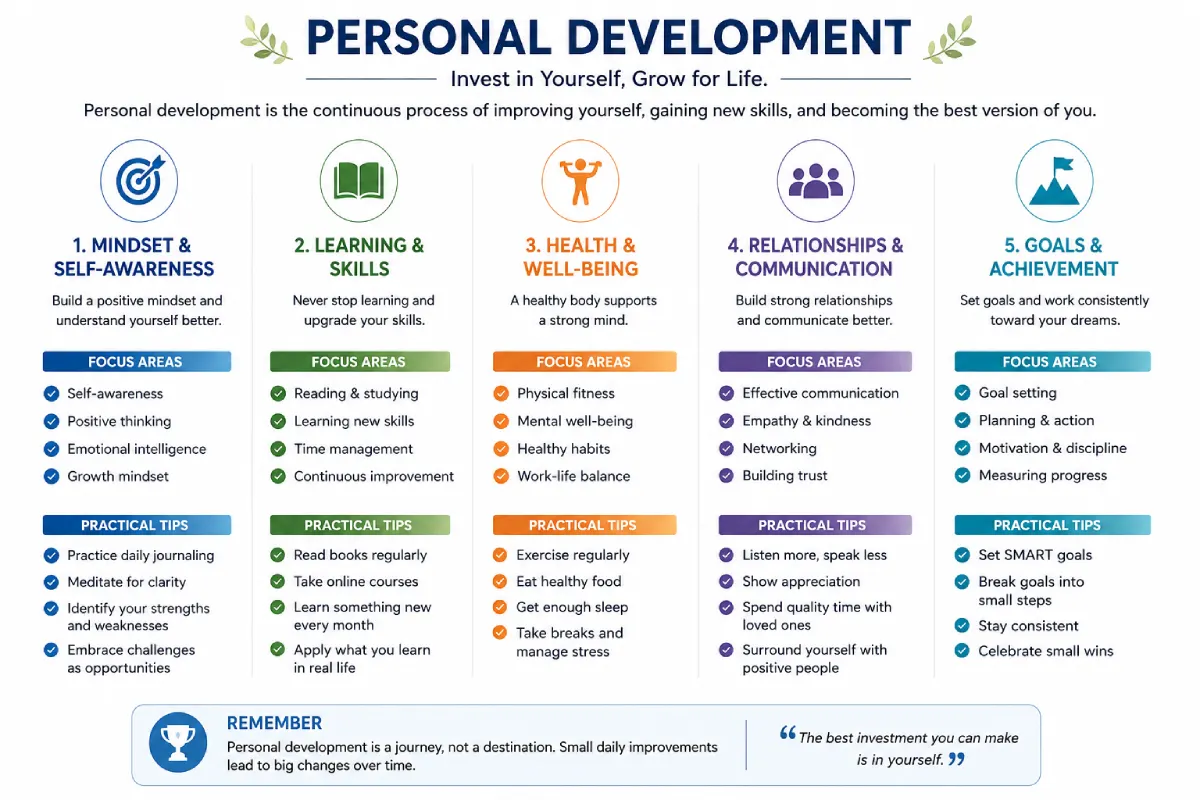
This cluster article expands the “Goal Setting” section of the Personal Development pillar page with the specific frameworks (SMART, worksheet structure, personal OKRs, long-term goal breakdown) that the pillar only introduces. It links back to the pillar hub and sideways to sibling clusters on habits, growth mindset, productivity, and confidence, strengthening the site’s topical authority around personal development as a connected system rather than isolated tips.