Best Home Wellness Workout Plan for Beginners in 2026
Published: June 15, 2026 Last Updated: June 16, 2026 A beginner home wellness workout plan should include 20–30 minutes
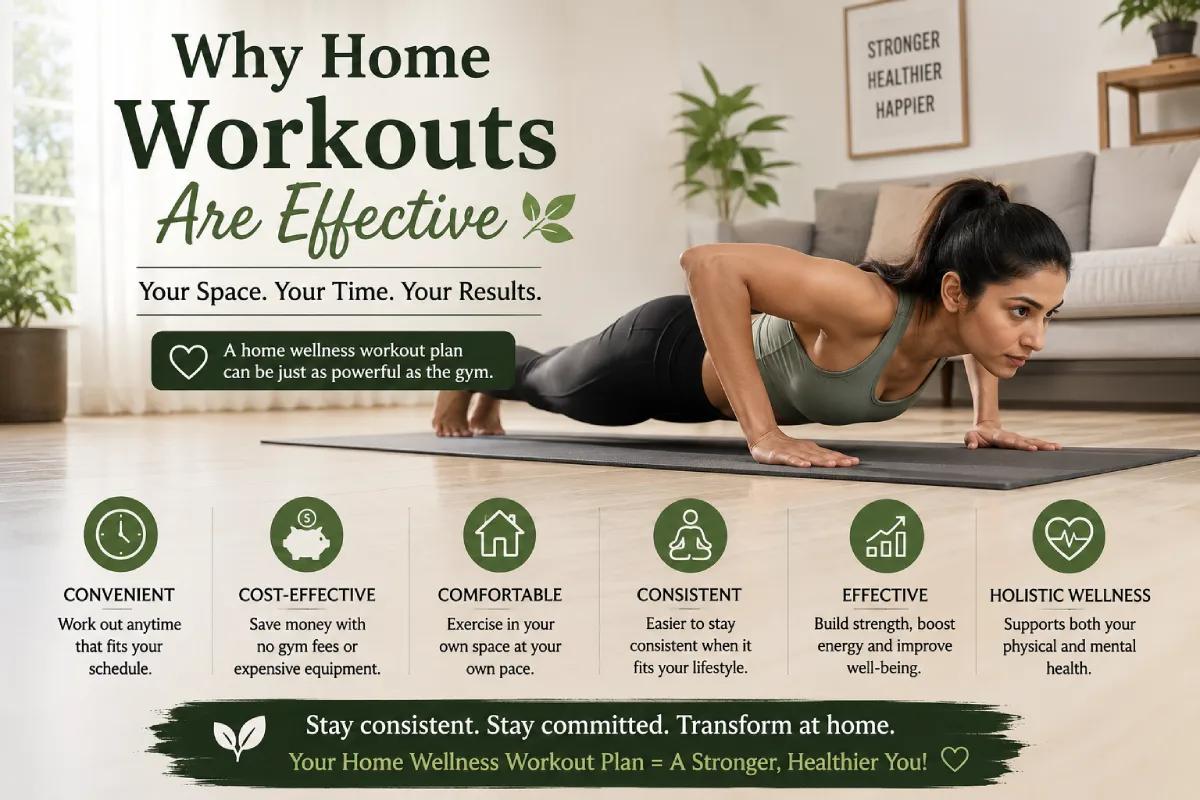
A beginner home wellness workout plan should include 20–30 minutes of bodyweight exercise, 3–5 days per week, with no equipment required. A simple weekly structure: full-body strength (squats, push-ups, planks) on Monday and Thursday, cardio (walking or jogging in place) on Tuesday, yoga or stretching on Wednesday, and a full circuit on Friday. Progress by adding sets in week three and reducing rest time by week five. Track reps, recovery speed, and sleep quality weekly to measure improvement. Prioritise 7–9 hours of sleep — it directly impacts strength, endurance, and motivation.
You don‘t need a gym, costly equipment or miles of spare time to become truly fit. A comprehensive home wellness workout plan on your body weight, your lifestyle and your surroundings is one of the best ways to create long-term core strength, vitality and mental lucidity.
Wherever you are Mumbai juggling hectic family commitments, or NY trying to shave 60 minutes off your daily commute this plan is designed for real life.
Why Home Workouts Are Effective (Not Just Convenient)
The greatest misconception about working out at home is that it‘s a compromise something you do when you can‘t make it to a gym. That‘s just wrong.
Workouts at home using bodyweight exercises are an effective method for gaining muscle and strength, developing your aerobic capacity and carrying off some bodyfat. It is not the place or the tools, it is the regularity, the challenge and the rest.
The most practically important principle in 2026 still holds: start at the right level for where your current fitness is at, advance gently, and focus more on programme adherence than intensity.
For the small Indian homes or the expensive US apartments with costly gym membership, a home workout plan eliminates all barriers between you and your achievement: actually showing up. And that barrier removal is what it takes in the long run.
📖 Read More: Fitness and Wellness Routines — The Complete Guide
Best No-Equipment Exercises for a Home Workout Plan
All you need is your body weight to get a complete, fully balanced workout. Strength Workouts using push-ups, planks and lunges. Cardio through high-intensity interval training. But the most important thing is to stay consistent and not have access to big weights.
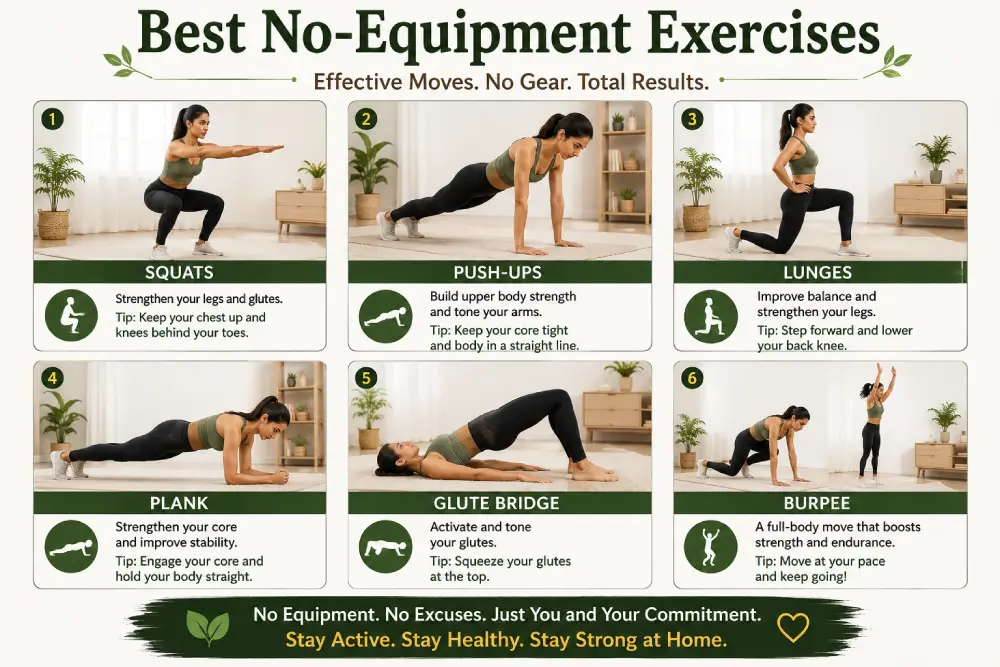
Here are the six foundational movements your plan should be built around:
Squats Sculpts the lower body, activates the glutes, develops core stability and is the most functional movement there is in any plan.
Push-Ups builds upper body and core strength. Lower modified push-ups on knees if needed until standard form can be achieved within 2–4 weeks.
Lunges single leg strength and balance. Switch legs, maintain a comfortable distance between knees. Make sure your front knee stays over your ankle, and tighten your core.
Plank Full body core stability. Start with 20 second holds and progress to 60 seconds in a four-week period.
Glute Bridges hip strength, lower back health & activation of the gluteus muscles important for those who maintain a seated position for extended periods of the day.
Burpees (Modified or full) Total body exercise that develops cardiovascular endurance, total body strength and conditioning in a single motion. Mod for beginners- step (not jump) back.
Prior to session 1, you‘ll need: a clear floor area for to work (about 6×4 feet), baggy clothes that you can move freely in and a source of water. That‘s it.
Weekly Home Workout Plan (Beginner-Friendly)
Beginner home workouts can improve fitness through sessions of 20 30 minutes on one or more of bodyweight exercises, cardio and stretching, focusing on safe form and gradual progression building through consistency 3 times a week.
Here‘s a simple 5-day structure that balances strength, cardio, and recovery:
| Day | Focus | Duration |
|---|---|---|
| Monday | Comprehensively body strength (squats, push-ups, lunges, plank) | 20–25 mins |
| Tuesday | Cardio brisk walk, jogging in place, dancing. | 20–30 mins |
| Wednesday | Active rest yoga or full body stretching, | 20 mins |
| Thursday | Lower body + core (squats, glute bridges, lunges, plank). | 20–25 mins |
| Friday | Full-body circuit (all six movements, 3 rounds) | 25–30 mins |
| Saturday | Light walk or Surya Namaskar (India) / casual cycling (USA) | Optional |
| Sunday | Full rest – ‘Sleep and hydrate’ | — |
For progression: in week three increase to 1 additional set for each exercise; by week five decrease rest between sets by 15 seconds; and emphasize, a ever-increasing workload in compound movements such as burpees and squats.
How to Stay Motivated at Home
The motivation,number one, is greatest at the beginning and predictably declines during weeks two and three. Being forewarned allows you to plan accordingly.
Anchor your workout to an existing habit. Do it immediately after your morning chai, before your shower, or right after you log off from work. Habit stacking takes away the daily decision of when to workout.
Make “miss two days at a time” the only rule you never break. One missed session means rest. Two missed sessions means it‘s becoming a pattern. The two-day rule is the most effective hack for motivation I‘ve found so far it takes real life into account while keeping a foundation intact.
Designate an area, even a tiny one. Just the act of unrolling a mat in a particular corner of your room each day tells your brain what you are about to do. Human environment design is undervalued.
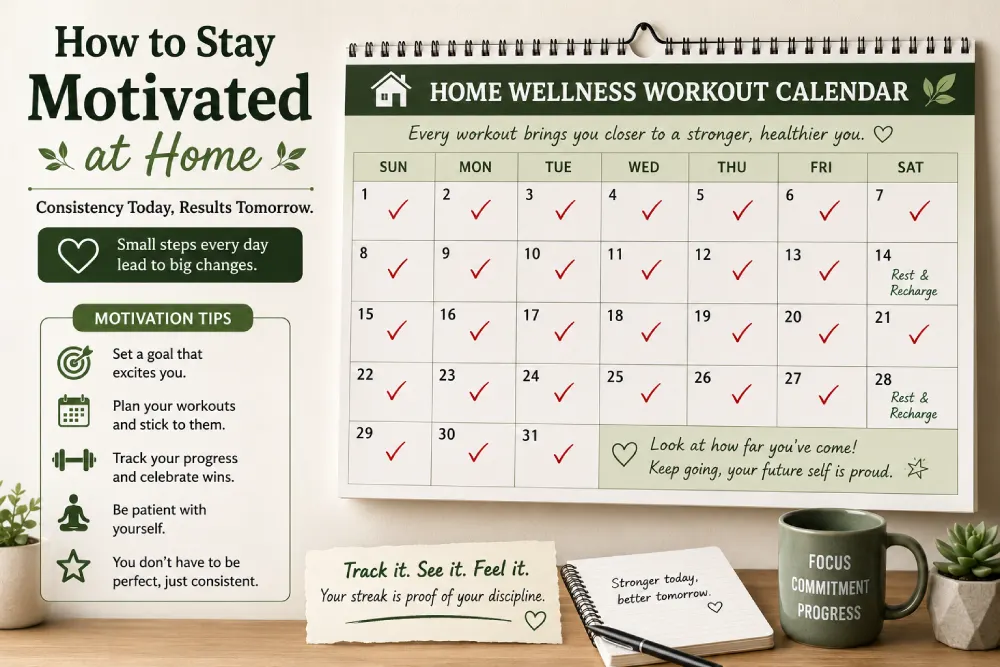
Tracking something visible. A wall calendar with each completed workout is one of the easiest ways to motivate yourself to remain consistent this is known as “tracking”. The psychological health benefits of performance of regular sport are one of the most reliably reported outcomes in public health: depression, anxiety, stress and cognition appear to all be benefited by exercise as much as in drugs being reminded of this has real utility when overcoming temptation to slack off.
Tracking Fitness Progress Without a Gym or Trainer
You don‘t need a personal trainer to know you‘re improving. Track these three things weekly:
Repetitions and sets. Are you able to do more push-ups this week than last? That‘s quantifiable, tangible progress.
Rest time. Are you recovering faster between exercises? Shorter rest with the same output is a clear sign of improved fitness.
Energy and sleep quality. Every Friday look back and reflect: Do I feel a good energy boost this week compared to a month ago?Is my sleep quality improving? These are the indicators that most beginners neglect and that have the greatest impact on their long term health.
Every single research study, every athletes performance test, shows that athletes sleeping 7–9 hours are superior to 5–6 hour sleepers in every condition measured power and speed, reaction time and emotional control. Sleep is a sport-specific training variable. Turn off the screens and treat it like one.
Record a 30-second video of a push-up or squat each month on your phone. Seeing how form progresses over time is one of the best (and free!) motivators.
📖 Read More: Health and Wellness — The Full Pillar Guide
Conclusion
A home Wellness workout plan is effective because you eliminated every excuse no commute, no dues, no waiting for a machine, no agenda that doesn‘t align with yours. Just find a cleared surface, 20–30 minutes, and show up more than you skip.
Begin with the weekly beginner plan. Perfect your six foundation exercises. Chart your improvements in reps, strength and sleep. Your home wellness workout guide, practiced daily for 8–12 weeks will deliver results you can‘t get by coveting the gym from your sofa.
FAQ SECTION
Q1: Is a home wellness workout plan effective without equipment?
Yes entirely, too. You simply use your weight to do yoga poses and strength training exercises at home without equipment. Push up, squat, plank, lunge and perform a glute bridge on the floor to work your strength, core and cardiovascular fitness.
Q2: How many days a week should a beginner work out at home?
Three to five days a week is a good training frequency. Your first step will be to stick to an exercise program at least three sessions a week for more than 8 weeks. Active rest such as walking or yoga on the days in between will make your training even more effective.
Q3: Is 20 minutes of home workout enough to see results?
Yes, if you are a beginner. New home workout programs make you fit in 20–30 minute workout sessions that consist of body-weight training, cardio workouts, and flexibility training, focusing on form, progression, and consistency 3x/week. Once you have built up strength, you should increase this to a 40-minute workout, or increase intensity.
Q4: What is the best home workout plan for beginners in India?
For Indian beginners, a home workout plan that includes between 10-12 cycles of Surya Namaskar incorporating aerobic, strength and flexibility work followed by body weight strengthening exercises like squats, plank, wall push-ups etc will work well without requiring any equipment. can be performed in 30 minutes.
Q5: How do I stay motivated to work out at home when I feel lazy?
Eliminate the choice altogether by linking your exercise to a current part of your daily routine (for example, a morning cup of tea or right after you finish work). Follow the two-day rule: don‘t miss two appointments in a row. Find a way to make it visible, even if on a wall calendar streak rather than a phone app.
Q6: How do I know if my home workout plan is working?
Track three things each week: if you are able to do more reps than the week before; if you are resting for less time (between sets); and if you are feeling more energetic and sleeping better. These three markers are better indications of real fitness improvements (over the scale weight) than weight loss, within that first month.