Skin Rash Treatment at Home: Natural Remedies for Fast Relief
Published: June 29, 2026 Last Updated: June 30, 2026 That suddenly red patch on your arm. The itchy area
That suddenly red patch on your arm. The itchy area that seemed to appear just after you switched to a new laundry detergent. Those papules that appeared in dramatic fashion after a long, hot, sweaty day. Rashes. They‘re annoying, frequently frightening, and almost always show up at the worst possible time.
Here‘s the scoop: In most cases, the body rash remedies you need to treat the skin rash don‘t involve a visit to the clinic. A skin rash treatment at home with common ingredients you should already have on hand can soothe the irritation, ease the itching and speed healing. But the trick is using the right remedy for the right type of rash
This guide tells you precisely what to use, when and, perhaps most important of all, when to stop.
Can Skin Rashes Be Treated at Home?
Yes many of them. Not all though.
Home treatment works well for:
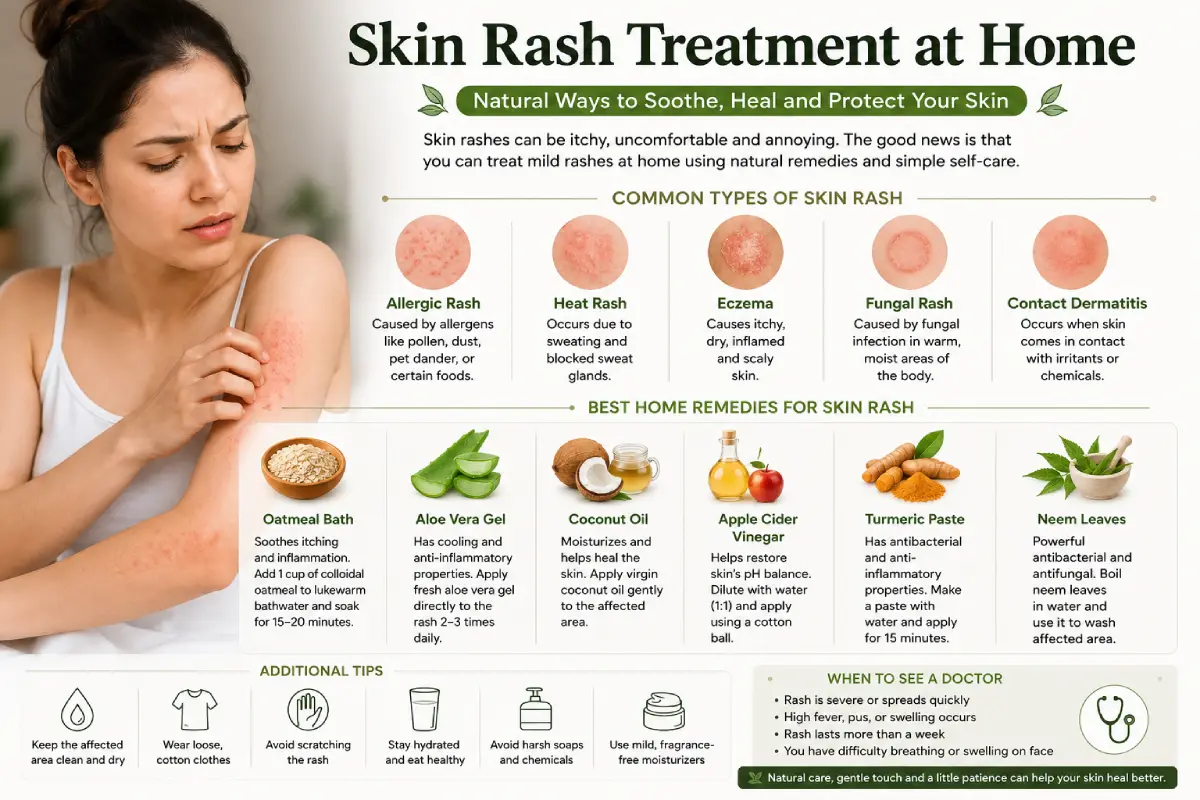
- Prickly heat (ghamori) Commonest type of rashes in India, more prevalent during summer and humid states.
- Mild contact dermatitis that caused by soap, jewellery metal, synthetic fabric and cosmetics.
- Insect bites/minor hives mosquito bites reactions, ant stings, irritation from dust-mite allergic reactions.
- Mild allergic skin reactions including: Redness from foods or environmental causes
- Minor flare-ups of eczema, which include dry, itchy areas that are not infected or weeping
Home treatment is not enough for:
- Fungal infections such as ringworm or jock itch (tinea) – these require treatment with an antifungal drug, and are not soothed.
- Bacterial infections which present as pus, hotness, or spreading redness
- Rashes secondary to viral infection such as chicken pox, shingles, and dengue.
- Any rash with fever, shortness of breath, or swelling of the lips and throat.
For a full breakdown of the different types of rash, causes and possible medical treatment options, read our complete guide to skin rash treatments.
Another golden rule: first identification, to then go to treat.
Best Home Remedies for Common Skin Rashes
What we have in fact worked matching to the rashes most encountered in India.
Aloe Vera Gel
Ideal for: prickly heat and and sunburn rash. Mild allergic reactions and insect bites.
Aloe vera this most versatile of all traditional topical remedies for irritated skin has been well-studied. When applied it has a soothing, cooling effect, reducing inflammation and mildly antimicrobial action that prevents secondary infection.
Application: Cut through a fresh aloe leaf and apply the gel over the affected areas, or use from the bottle a pure mixture from the shop (not scented for sensitive skin). Apply 2–3 daily.
Pro tip: Put the gel in the fridge for 20 minutes before putting it on. The cold sensation on the prickly heat (almost) works straight away.
Cold Compress
Suitable for: Any rash which has heat, swelling or severe itching.
A cold pack constricts the blood vessels, immediately decreases inflammation and disables the itch impulse. It‘s not a cure, but is provides quick relief while other methods work underneath.
How to use. Take 2-3 ice cubs and wrap them with a clean cotton towel. Use it to rub on the rashes for 10-15 minutes. Never place ice directly on the skin as it will cause ice burn.
Coconut Oil
Best for: Dry, flaky rashes; eczema; mild contact dermatitis; dryness after rash.
Virgin coconut oil contains high lauric acid, which has a calming effect on anti-inflammatory and microbial conditions. It creates a protective barrier on the skin and helps lock in moisture, alleviating itchiness brought on by dryness.
Method of use: Take a very thin layer of cold pressed virgin coconut oil on the part 2–3 times daily.
Note: Do NOT use coconut oil on prickly heat or sweaty rashes. It is hot and sticky and makes the prickly heat or sweaty rashes a thousand times worse.
Neem
Best for: fungal rashes (early stage), skin irritation caused by bacteria, heat rash
Neem is one of India‘s most traditional cures to rashes because of its strong antibiotic, anti-inflammatory and antifungal nature. Neem may be bought as neem leaves, neem powder or neem oil.
Application: Boil a few neem leaves in a cup of water, cool and use the water as a wash for the rash or Mix the neem powder with a little water and form a paste, apply on the rash for 15mins and then rinse.7. Neem leaves added to bath water work really well at bath time in the monsoon season.8. Neem powder applied to the rash by itself.
Oatmeal Paste or Bath
Best for:Those covering widespread rashes, caused by eczema, hives, chickenpox, dry and irritated skin
Colloidal oatmeal (finely ground oats) protects the skin barrier and soothes inflammation and pruritus particularly useful for large or diffuse eruptions for which spot-treatment isn‘t feasible.
Preparation:Powder regular oats or oatmeal and add 1 cup to tub of lukewarm water. Relax for 15–20 minutes. For a smaller rash mix the oatmeal with water, making a paste, and spread over affected areas for 10 minutes.
Say no to hot water heat intensifies most inflammatory rashes.
Turmeric and Honey Paste
Best for: Slightly infected rashes, insect bites, mild eczema patches.
Curcumin the active component in Turmeric already has anti-inflammatory and anti-microbial properties documented. Along with raw honey (also antibacterial), the paste combated both irritation and bacteria on the surface.
Preparation: Mix ½ teaspoon turmeric powder with 1 teaspoon raw honey. Apply to the rash for 15–20 minutes and then rinse off with cool water. Repeat once daily.
Note: When used, turmeric will temporarily stain skin. Wash off with a drop of milk or gentle cleanser.
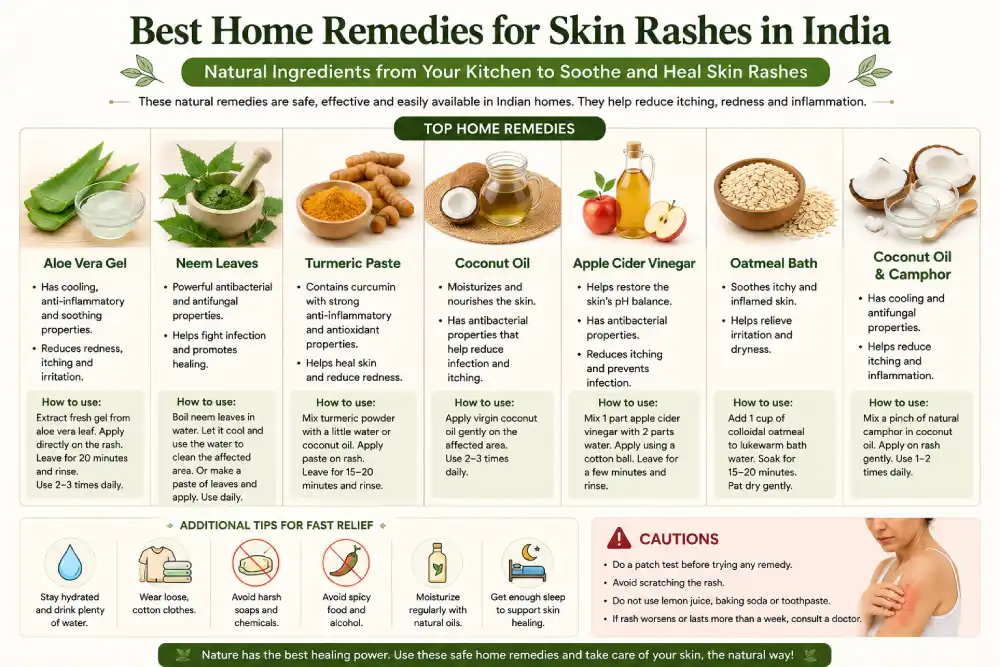
Natural Ingredients That Soothe Irritated Skin
A quick-reference table for India‘s kitchen and pharmacy shelf:
| Ingredient | Best Rash Types | How to Apply | Avoid For |
|---|---|---|---|
| Aloe Vera | Heat rash and sun burn, bites pp0- | Direct gel, 2–3x daily | Latex-sensitive individuals |
| Cold Compress | Any heat or itchy such as rashes | Cloth-wrapped ice, 15 min | Open or blistered rashes |
| Coconut Oil | Dry rashes, eczema | Thin layer, 2–3x daily | The prickly heat, sweat ragged skin folds |
| Neem | Fungal irritation, bacterial rashes | Paste or leaf wash | Pregnancy (internal use only) |
| Colloidal Oatmeal | Widespread itch, hives | Bath soak, 15–20 min | None — very gentle |
| Turmeric + Honey | Minor infected patches | 13. Paste, 15 min, once per day. | Simple Open wounds or broken skin |
| Baking Soda | Urticaria, insect bites, pH-sensitive itchi | In a lukewarm bath, add 1 tsp. | Extremely dry or sensitive skin |
See more on medical creams, and when you should get more advanced home care under control by looking at our guide to skin rash treatment.
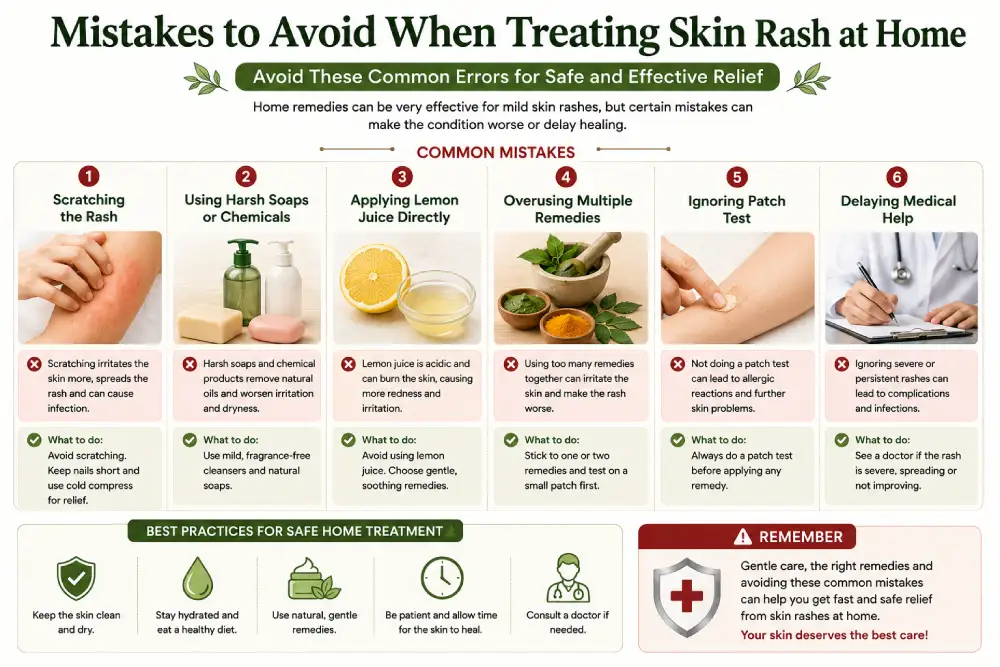
Mistakes to Avoid When Treating a Rash
This is how most people mess up and how a simple rash turns into a bigger thing.
Lemon Juice applied Topically. Highly acid and photosensitising. Applying lemon juice to a rash especially on the skin before going out into India‘s sun can result in chemical burns and hyperpigmentation, which can take months to disappear. Avoid completely.
Toothpaste A common myth online. Actually, toothpaste contains ingredients (menthol, fluoride, detergents) that irritate inflamed skin. It doesn‘t clear rashes up it can exacerbate them.
Scratching When you scratch you open the skin surface, introduce bacteria, and release even more histamine (which worsens the itching rather than relieves it). Scratching also puts you at a high risk for infection and scarring.
Use of coconut oil or rich creams on heat rash Heat rash is the results of clogged sweat ducts, an occlusive product such as coconut oil seals the ducts causing more heat and worsening the rash, rather opt for a light water based gel or rinse with water.
Using others’ prescription cream A frequent practice in Indian families pteesSharing the last few doses of steroid cream or the entire tube of antifungal. Using the wrong pt prescription cream(sometimes a steroid on a fungal rash) exacerbates the infection and prolongs healing for weeks.
Not performing a patch test Every natural product will cause a reaction. Test on the inside of the wrist 24 hours before applying to face, neck or a large area of the body.
Myth vs Fact: Home Rash Treatment
Myth: All natural ingredients are safe on rashes. Fact: Essential oils (undiluted), lemon juice, and even aloe vera may cause a skin reaction if a person is allergic or sensitive to it. Natural does not mean safe for everyone. Always do a patch test.
Myth: If your rash doesn‘t itch, it can‘t be serious.. Fact: Some very serious rashes, such as drug reactions and early shingles, may not itch at all. The shape and spread of the rash and any other symptoms are more important than the itchiness.
Myth: Home remedies can treat a fungal infections such as ringworm. Fact: Neem and tea tree oil both have antifungal properties, but are not sufficiently powerful to treat a pre-existingtinea infection. Antifungal cream (clotrimazole or terbinafine) required available OTC at any Indian pharmacy.
Misconception: The rash is gone if it fades briefly. Reality: Contact dermatitis and eczema come and go. If the offending agent (soap, fabric, food, jewellery) isn‘t identified and eliminated, the disease will keep returning.
Signs That Home Treatment Is Not Enough
Stop home treatment and see a doctor if any of the following apply:
- The rash is extending out of the initial patch so spreading quickly.
- There is evidence of pus, oozing or crusting.
- Rash with fever, chills or body aches
- You see swelling of the lips, throat or face this is a medical emergency
- The eyes, face, or genitals.
- No improvement after 5–7 days of regular home care
- You have diabetes or if you‘re immunocom-promised infections get worse faster so will require supervision
- The rash developed after the commencement of a new medication
This is during the monsoon season in India ( July-September), when fungal rashes, infected insect bites and bacterial skin infections are prevalent. If your rash is seen in high humidity and is not resolving in 3-4 days, see a doctor earlier.
The right at home skin rashes treatment can really work for most mild cases. Use aloe vera for cooling, neem for antimicrobial, oatmeal bath for widespread itching and cold teapacks as an immediate cooling. Avoid lemon juice, the urge to scratch and the toothpaste. And when rash won‘t go, or signals trouble, see a doctor.