How to Build Emotional Resilience in 2026 (Science-Backed)
Published: September 3, 2026 Last Updated: September 3, 2026 Whenever we hear about emotional resilience, it‘s usually presented as

Last Updated: September 3, 2026
Whenever we hear about emotional resilience, it‘s usually presented as if it‘s a personality characteristic, you‘ve either got it or you don‘t. It isn‘t. Resilience is a set of learnable skills for recovering from stress and adapting to change, and like any skill it improves with practice, not just grit.
What Emotional Resilience Actually Means
Resilience does not imply you will not experience stress, grief or setbacks. It implies you will not be overwhelmed by these conditions and will, in fact, be able to rise above them — perhaps more quickly each time you re-hearse your resilient strengths. For example, the resilient individual still will grieve after a serious setback; he or she just do not linger in the grief for any extended period of time.
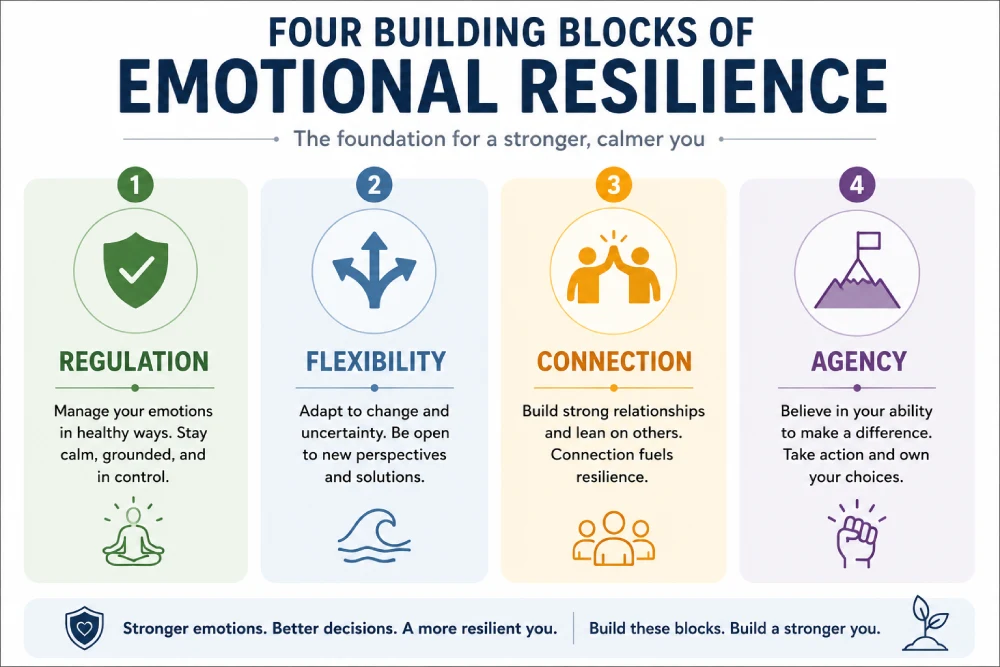
The Four Building Blocks of Resilience
1. Regulation of emotion The ability to experience an emotion strongly but not be totally overwhelmed by it. Not suppression, more like the expansion of the space between experiencing it and doing something about it.
2. Cognitive flexibility. When you can look at a setback from several perspectives instead of getting stuck on just one, often negative, view.
3. Social support. Hurting people converge on others rather than withdraw from them – social integration and support is a consistently strong predictor of growth from adversity.
4. A feeling of agency. Feeling that you are actively struggling rather than finding yourself manipulated.
Emotional Regulation: A Practical Skill You Can Train
When a powerful emotion strikes, most people either push it away or are overwhelmed by it. Resilience exists in between:
- Name it clearly. Don‘t say “I feel bad” say “I‘m disappointed” or “I‘m hurt.” The more exactly you identify an emotion, the less intense it will feel.
- Allow it to wash over you. Allow 60–90 seconds before reacting or responding as most emotional peaks rise and fall within that time frame.
- Decide intentionally. Do I really need to take action on this (another conversation, setting a boundary), or do I just need to feel it, then let it go?
The same naming-allownacting framework is also covered on a deeper level in our emotional wellbeing guide.
Coping With Change: A Step-by-Step Approach
Change losing your job, moving, breaking up with someone that‘s where resilience faces its greatest challenge. Here is an exercise to try when a major change occurs:
- Distinguish between fact and story. ‘Lost my job’ is fact. The story ‘won‘t ever get anything this good again’ is your anxious brain adding in.
- Determine what you are actually able to do at this moment. A small task you can do today is to just update your resume or call a single contact.
- Give it time. All change requires the dying of what‘s knowna€”expect to mourn it, but don‘t linger in the mourning.
- Just do one small thing each day. Building momentum even when it’s as small as a small step can help you recover your sense of ability more quickly than waiting to “feel ready.”.
Mental Toughness Tips That Actually Work
Mental toughness” is frequently misinterpreted as “clenching the teeth and suppressing emotion,” but the evidence-based understanding of mental toughness does not resemble;
- Reframe setbacks as only temporary (not permanent). “This is a hard month” rather than “this is how things are now”.
- Separate self-worth from outcomes. A failed project reflects one attempt, not your entire capability.
- Build a resilience “reserve” before you need it — sleep, movement, and connection aren’t optional extras, they’re what your nervous system draws on during a hard stretch. Our mental wellness guide covers how these pieces work together.

Resilience Skills to Practice on Calm Days
Resilience is not just developed in critical situations – the capacity to perform when under stress, is in the habit of performing well:
- Mindful pauses before reacting to minor frustrations build the same muscle you’ll need for bigger ones. Our mindfulness for beginners guide is a good starting point.
- A short daily meditation practice trains the same “notice and return” muscle that emotional regulation relies on — see our meditation for beginners guide to get started.
- Your support system: check in with them, not just during emergencies, when regular days are happening.
Common Mistakes People Make With Resilience
- Confusing resilience with never having a difficult time. Resilient people find it hard, yes but they don‘t remain in pain so long.
- Attempting to “think positive” while enduring a genuine setback. If the emotional stage is bypassed it can back fire and come out again later, usually as crankiness or fatigue.
- To be isolated during difficult times is, perhaps, to be deprived of the one of the most powerful resilience factors social connection.
Myth vs. Fact
| Myth | Fact |
|---|---|
| Resilient people do not become upset. | Resilient people feel their pain completely they just don‘t hang out in it. |
| A natural born trait. | It‘s a range of skills that enhances with practice, no matter your age. |
| Brampling: Toughness means managing everything single-handedly. | Relying on others is one of the strongest predictors of bouncing back from stress. |
Building Your Resilience Routine
Start with one building block, not all four at once:
- If you‘re an emotional rollercoaster start out with the name-allow-act.
- If blows are unbearable, take time to practice reentering this week (“Temporary not permanent, comfortable not cozy”).
- If you tend to go into your shell when you‘re stressed, make one small connection a call, a coffee a weekly habit no matter how you feel.
For a more expansive daily structure that integrates resilience-building with sleep, exercise, and mindfulness, check out our guide to healthy habits.
This is not about being numb. It‘s about making the gap between a hard time and good footing smaller and the smaller it is, the faster you start moving back.
FAQs
What is emotional resilience? It is the learned capacity to experience stress, sadness, or failure deeply and not get “stuck” there instead be able to recover from it.
Can resilience be learned or it is coming out of the way you are? YES, it can be learned. Resilience is learned through specific skill development such as emotion regulation, cognitive flexibility and social support.
Which resilience skills are the most effective to use? Clearly label your emotions, put setbacks into perspective as only temporary, do small steps to change on a daily basis, and stay connected with others.
How can I develop mental toughness without suppressing my emotions? True mental toughness is a paradigm shift the turning off of self-esteem as a function of results and a stretching of time between setbacks and the next clear conscious contact. It also requires you first experience the emotion.
Is there an easier way to deal with a major life shift? Learn to distinguish reality from the fearful “story” your mind invents, focus on the aspects you can influence, sit in the pain of transition, and perform a little daily action to regain forward motion.
Does social connection actually influence resilience? Absolutely relying on other people in tough times is by far the most reliable factor in resilience, more than simply having self-control.
Final Conclusion
Emotional resilience isn‘t about feeling less – it‘s about bouncing back quicker and that‘s a skill anyone can develop with time. Pick one “block” naming emotions, reframing a setback, or leaning into community and use it repeatedly until it becomes ingrained in your comprehensive mental health regimen.