Best Morning Skincare Products for Every Skin Type
Published: June 11, 2026 Last Updated: June 16, 2026 The best morning skincare products are a gentle cleanser, a
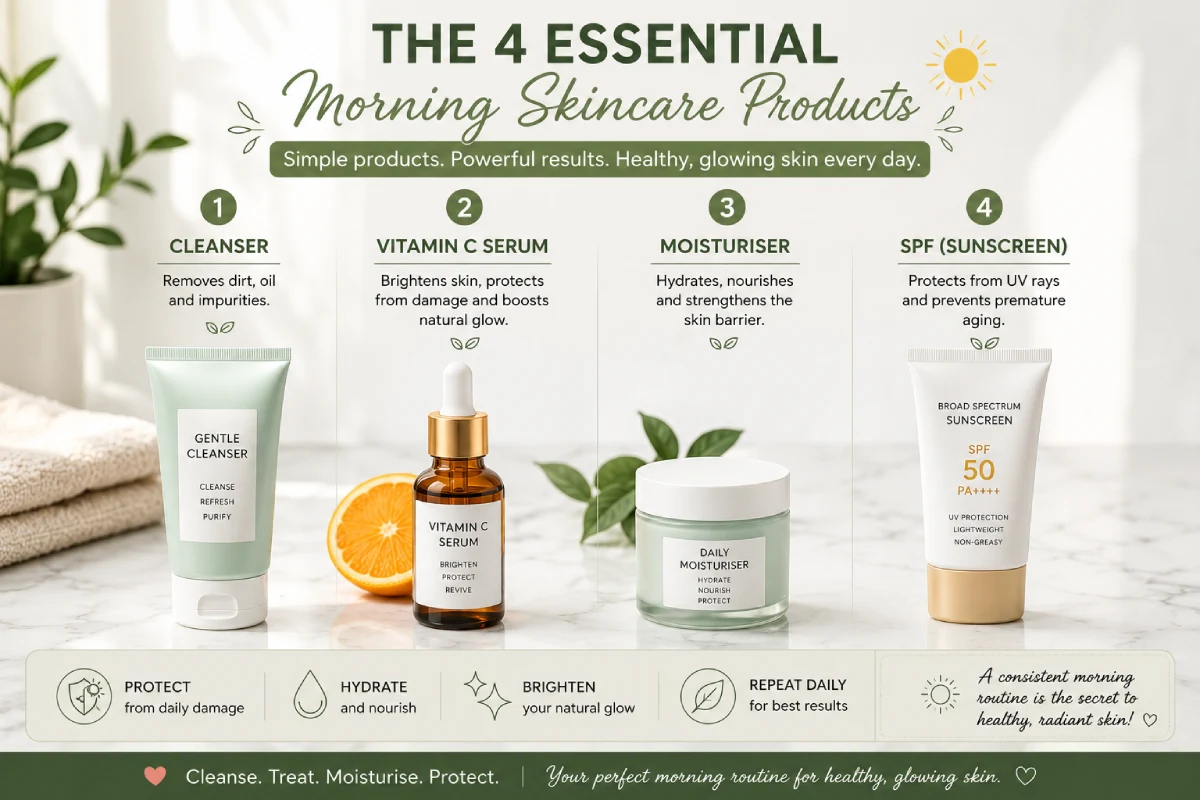
The best morning skincare products are a gentle cleanser, a Vitamin C serum, a moisturiser suited to your skin type, and a broad-spectrum SPF 30–50. Apply them in order from thinnest to thickest: cleanser first, then serum, then moisturiser, then SPF last. This four-step routine protects the skin from UV damage, pollution, and moisture loss throughout the day.
Here’s your no-fluff guide.
Getting yourself out with your morning skincare products shouldn‘t be any trouble. Tough London mornings that are grey and sticky? Or Mumbai‘s hot humid masses? Same products do the trick in both – you just need to get the right ones for your skin type.
Here’s your no-fluff guide.
The 4 Essential Morning Skincare Products You Actually Need
You need not ten steps. You need the right four.
1. Gentlest cleaner Begin with a gentle cleanser that washes away all the oil and residue accumulated over night without leaving your skin feeling tight. If you have dry or sensitive skin search for sulphate-free cleansers. Gel cleansers are perfect for oily and combination, whereas cream cleansers are great for dry skin.
UK pick to look for: CeraVe Hydrating Cleanser India pick to look for: Minimalist Salicylic + LHA Cleanser (for oily skin) or Cetaphil Gentle Skin Cleanser (for dry/sensitive)
2. Vitamin C Serum This is your morning antioxidant shield. Vitamin C protects against pollution and UV damage, brightens uneven tone, and gives that “lit from within” glow. It’s especially effective in Indian cities where pollution levels are high.
Use it after cleansing, 2–3-minutes wait and step 2.
3. Moisturiser Yes oily skins require moisture also. A lighter, non comedogenic moisturiser will help you keep a healthy skin barrier with which in turn will help prevent excess oil production.
Dry skin? Choose a cream-based formula with hyaluronic acid or ceramides. Oily skin? Use a gel-based moisturizer which won‘t clog pores.
4. SPF- Non-Negotiable Sunscreen is the most powerful product you will use in your entire regimen. SPF 30+ everyday, 365 days a year will prevent premature ageing, hyperpigmentation and cumulative long term damage by the Sun. In Indian conditions SPF 50 is advisable.
Use it at the very end. Each morning. All of the days when the sun is behind the clouds.
📖 Want to know the full step-by-step process? Read More: Morning Skincare Routine — The Complete Guide
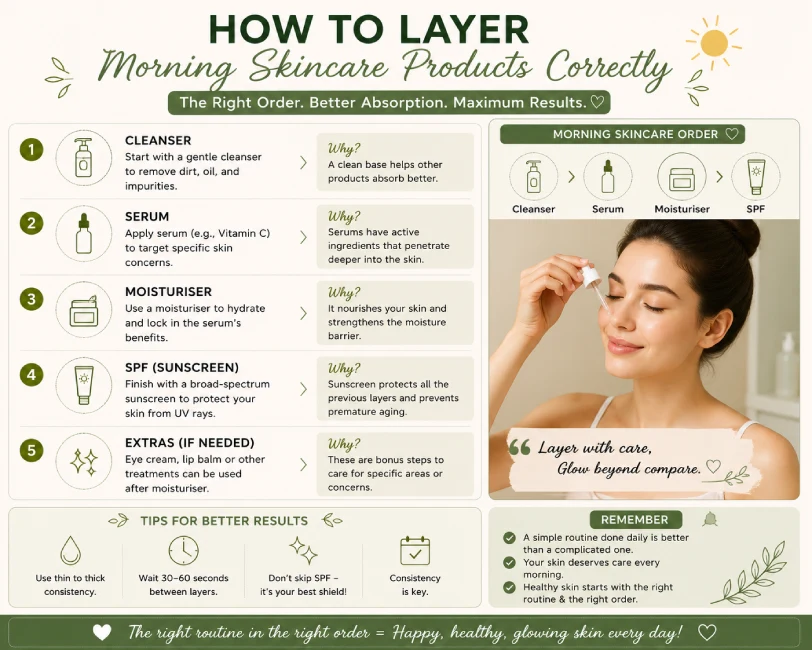
How to Layer Morning Skincare Products Correctly
Order matters more than most people realise. Apply products from thinnest to thickest consistency:
Cleansing→Toner (optional)→Serum→Moisturiser→SPF
A few layering rules to remember:
- Allow your Vitamin C serum to absorb for 2–3 minutes before following with moisturiser
- Don‘t combine Vitamin C and niacinamide in the same step use them separately. For instance use the Vitamin C serum, wait 15-20 minutes, then follow up with the niacinamide serum.
- Finally your SPF is applied, it always goes on last after moisturiser.
- If using an eye cream, follow serum with eye cream then moisturiser
The method of thin-to-thick will seal each piece that is completely absorbed and not sprawled over the other.
Serums vs Moisturisers: What’s the Difference?
This is one of the most common questions and it is understandable as to why.
Serums are super-lightweight, power-packed formulas designed to target specific concerns (brightness, hydration, dark spots). They come before moisturiser.
The moisturisers stop everything getting out and uphold the barrier of your skin. They‘re not a substitute; you should usually have both.
Imagine a serum as the treatment and a moisturiser as the protector. Use them together, one after the other.
Best SPF Products for a Morning Routine
Not all sunscreens are the same. Here‘s what to know:
Chemical SPF absorbs UV rays and converts them to heat. Lightweight and invisible — great for everyday wear under makeup.
Mineral SPF (zinc oxide or titanium dioxide) forms a reflective barrier on the skin and reflects and blocks UV rays. Best for sensitive skin.
For Indian skin tones, tinted mineral SPFs will help to avoid the white cast many experience with conventional formulas.
For the UK, a hybrid SPF which is hydrating as well as protective is suitable for the winter months when the weather may be cooler and drier.
📖 Building your full routine from scratch? Read More: Complete Skincare Routine Guide
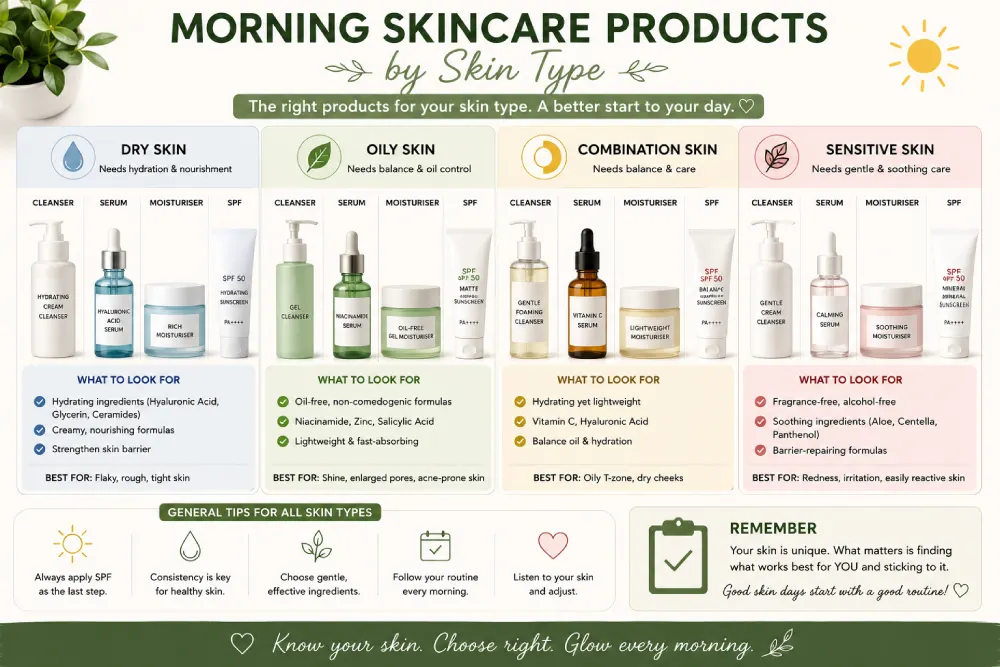
Morning Skincare Products by Skin Type Quick Reference
| Skin Type | Cleanser | Serum | Moisturiser | SPF |
|---|---|---|---|---|
| Dry | Cream/milk | Hyaluronic acid | Rich cream | Hydrating SPF 30–50 |
| Oily | Gel/foaming | Niacinamide or Vit C | Gel formula | Matte or gel: SPF 50 |
| Combination | Gentle gel | Vit C or niacinamide | Lightweight lotion | Fluid SPF 30–50 |
| Sensitive | Fragrance-free cream | The plant Centella or Vit C (L-AA free) | Barrier cream | Mineral SPF |
The Most Common Morning Skincare Mistakes
‘Sending’ SPF in on overcast days. Sun‘s rays reach through the clouds. This one error will account for the bulk of unnecessary skin aging.
Applying too many actives at once. If you’re using Vitamin C, AHA, BHA, and retinol all at once in the morning — stop. Morning is for protection, not heavy treatment.
Not taking time between layers. When you rush, the products aren‘t soaking in wait a full 60 seconds in between!
Maintaining the same moisturizer year-round. As the seasons change- your skin varies in winter compared to summer and even in different regions. Change your moisturizer accordingly.
Conclusion
The best morning skincare don‘t have to be the most costly, they just need to suit your skin and be regular. A cleanser, followed by a vitamin C serum (search for one that includes hyaluronic acid – it‘ll make an enormous difference to your skin), then a moisturiser to lock it all in, and finally a SPF. Twenty-five seconds a day for those four steps and you‘ll notice a real change.
Build your morning skincare around protection every morning, treatment at nighttime. That‘s the formula.
FAQ SECTION
Q1: What are the essential morning skincare products for beginners?
For all beginners, this is all you need; a mild soap or foam to wash your face, a Vitamin C serum, a moisturizer that is compatible with your skin type and an SPF 30 or higher broad spectrum. That‘s a complete morning regimen.
Q2: Which goes first — serum or moisturiser?
The serum is always applied before the moisturiser; a serum is usually much thinner and requires direct contact with the skin to penetrate, whereas a moisturiser is usually thicker and is used to form a barrier on top of everything else including the serum.
Q3: What morning skincare products are best for Indian skin?
For Indian skin, you should look out for a Vitamin C serum to brighten and protect against pollution, a lightweight gel moisturiser, and a high SPF (50+) sunscreen. If you have uneven skin tone or dark spots, go for a niacinamide product.
Q4: Do I need a toner in my morning routine?
Welcome to flexibility and choice! A toner is optional. Use if you want/have one to use after cleansing and before serum. Many water-based toners contain hyaluronic acid, a good extra shot of water and will sit well under moisturizer.
Q5: Is SPF 30 enough for everyday use in the UK and India?
SPF 30 would be fine for most day-to-day use in the UK. In India SPF 50 would be generally suggested as there is a much higher intensity of UV, particularly in the summer and further south.