20 Self-Improvement Habits to Transform Your Life in 2026
Published: August 24, 2026 Last Updated: August 24, 2026 Self-improvement habits don’t need to be dramatic to work. The
Last Updated: August 24, 2026
Self-improvement habits don’t need to be dramatic to work. The people who actually change their lives aren’t running 30-day extreme challenges — they’re stacking small, repeatable actions onto routines they already have, and getting 1% better daily instead of chasing a single big leap.
This guide gives you 20 practical habits, grouped by category, along with the two ideas that make them stick: habit stacking and keystone habits — the small number of habits that pull everything else into place.
What Makes a Habit “Self-Improvement” (Not Just a To-Do)
A self-improvement habit is a small, repeated behavior tied to a stable cue, done consistently enough that it becomes automatic. The goal isn’t intensity — it’s frequency. A five-minute daily habit beats a two-hour weekend ritual almost every time, because consistency compounds and intensity doesn’t survive a busy week.
Habit Stacking: The Fastest Way to Start
Habit stacking means attaching a new habit to one you already do without thinking — brushing your teeth, making coffee, sitting down at your desk. The formula: “After [current habit], I will [new habit].”
Examples:
- After I pour my morning coffee, I will write down my top 3 priorities for the day
- After I brush my teeth, I will write two lines in a journal
- After I sit down at my desk, I will silence my phone for the first hour
This is the backbone of an atomic habits routine — small actions, stacked onto existing behavior, that don’t require extra willpower to remember.
Keystone Habits: The Ones Worth Prioritizing First
Not all 20 habits below carry equal weight. Keystone habits are the few that naturally trigger other good behavior — start here if you’re overwhelmed:
- Consistent wake time — anchors sleep, morning routine, and daily structure
- Daily movement — even 10 minutes tends to improve food choices, sleep, and mood
- A nightly weekly review — 15 minutes on Sunday that keeps every other habit honest
Master one keystone habit before adding the rest — it does more work than any other single change on this list.
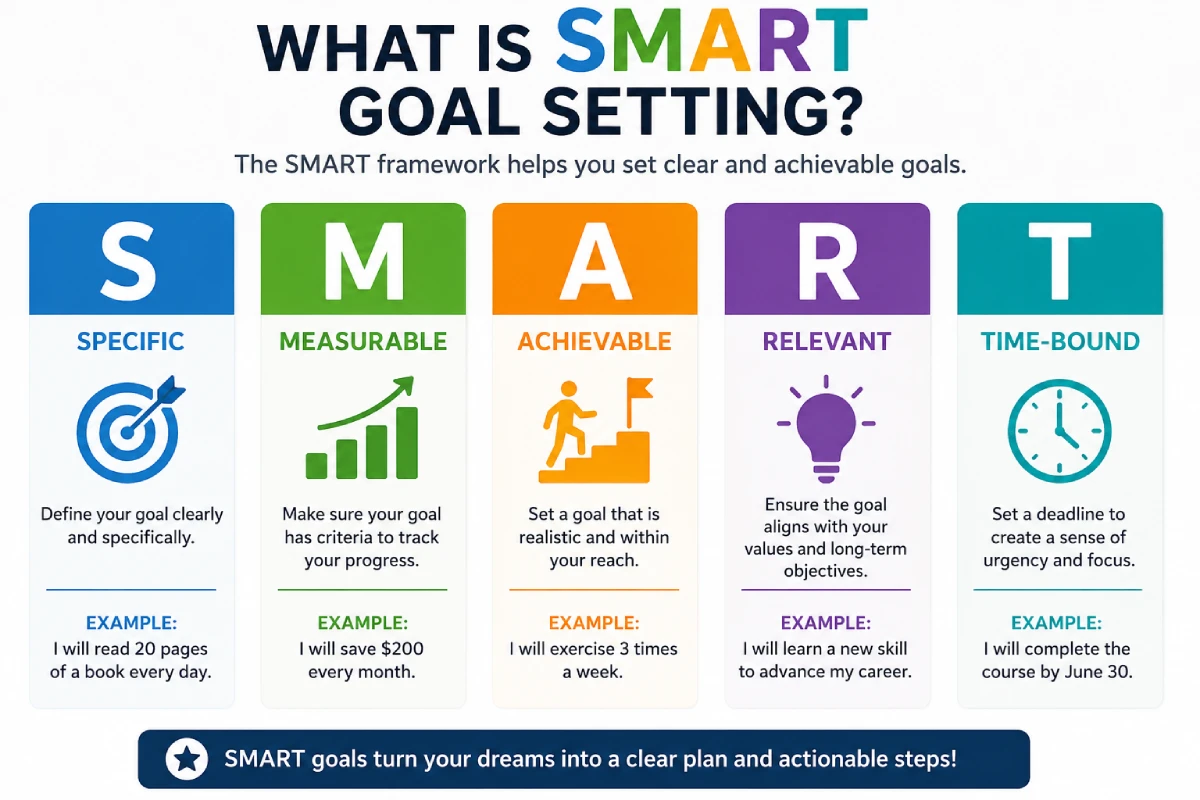
20 Self-Improvement Habits, Organized by Category
Mindset & Reflection
- Journal 2–3 lines daily — what worked, what didn’t
- End each day asking, “What did I learn today?”
- Do a 15-minute weekly review every Sunday
- Reframe failure as data, not identity (“that approach didn’t work” vs. “I’m bad at this”)
Habits & Discipline 5. Use the two-minute rule — start ridiculously small (one page, one push-up) 6. Habit-stack one new behavior onto an existing routine 7. Design your environment instead of relying on willpower (shoes by the door, phone in another room) 8. Track one habit with a simple yes/no log, not a complicated app
Productivity 9. Choose your top 3 priorities the night before, not a 20-item list 10. Time-block one hour of deep, uninterrupted work daily 11. Single-task instead of multitasking — it’s faster, not just calmer 12. Batch small admin tasks instead of scattering them through the day
Confidence 13. Keep a “proof file” of moments you handled something hard 14. Do one small uncomfortable thing weekly — an email, a question, a introduction 15. Fix posture consciously during stressful moments — it measurably affects how you feel 16. Limit social comparison scrolling to a set time, not idle moments
Learning & Growth 17. Read or learn for 20 minutes daily instead of a weekend binge 18. Teach or explain what you learned to someone else — it exposes real gaps 19. Stack two decent skills instead of chasing mastery in just one 20. Review your goals monthly and adjust — most goals shift shape over a year
Common Mistakes with Self-Improvement Habits
- Starting all 20 at once — pick 1–2 and let them compound before adding more
- Copying someone else’s exact routine — a 5 am wake-up that works for one person may not fit your schedule
- Judging progress only by outcomes — process consistency matters more early on
- Quitting after one missed day — a single skip is a blip, not a failure
Myth vs. Fact
| Myth | Fact |
|---|---|
| You need discipline to build lasting habits | Environment design consistently beats willpower over time |
| Bigger changes create bigger results | Getting 1% better daily compounds faster than occasional intense effort |
| All habits matter equally | Keystone habits like consistent wake time or daily movement carry more leverage than the rest |
Self-Improvement Checklist: Your First 2 Weeks
- [ ] Pick one keystone habit to start (wake time, movement, or weekly review)
- [ ] Write your habit-stacking formula: “After ___, I will ___”
- [ ] Track it daily with a simple yes/no log
- [ ] Do your first weekly review after 7 days
- [ ] Add a second small habit only once the first feels automatic
7. FAQs
What are self-improvement habits? Small, repeated behaviors — tied to a consistent cue — that compound over time to improve your mindset, discipline, confidence, or skills, without relying on motivation or willpower alone.
What is habit stacking? Habit stacking means attaching a new habit to an existing routine using the formula “After [current habit], I will [new habit],” which makes the new behavior easier to remember and repeat.
What are keystone habits? Keystone habits are the small number of habits — like consistent wake time or daily movement — that naturally trigger other positive behaviors, making them the highest-leverage place to start.
How does the 1% better daily approach work? Instead of chasing big, dramatic changes, you focus on tiny, consistent improvements each day. Over months, those small gains compound into significant results — more reliably than occasional intense effort.
How many self-improvement habits should I start with? Start with just one or two, ideally a keystone habit. Adding all 20 habits at once is one of the most common reasons self-improvement routines fail within a few weeks.
8. Featured Snippet Opportunities
- Definition box: “What is habit stacking?” — answered with the formula in the opening sentence, ideal for a paragraph snippet.
- Numbered list: “20 Self-Improvement Habits, Organized by Category” — already structured for a list-type snippet.
- Table: “Myth vs. Fact” — well-suited for a comparison snippet.
- Checklist: “Self-Improvement Checklist: Your First 2 Weeks” — structured for a checklist-style snippet.
9. Image Suggestions
H2: What Makes a Habit “Self-Improvement” (Not Just a To-Do)
- Image idea: Person writing in a small notebook with a coffee cup, calm desk setup
- Filename:
self-improvement-habits-basics.webp - ALT text: “Person building a self-improvement habit with daily journaling”
H2: Habit Stacking: The Fastest Way to Start
- Image idea: Simple flow diagram showing “After coffee → journal → 3 priorities”
- Filename:
habit-stacking-formula-example.webp - ALT text: “Habit stacking formula example for self-improvement routines”
H2: Keystone Habits: The Ones Worth Prioritizing First
- Image idea: Illustration of one domino triggering a row of smaller dominoes
- Filename:
keystone-habits-domino-effect.webp - ALT text: “Keystone habits triggering other positive behaviors, domino effect illustration”
H2: 20 Self-Improvement Habits, Organized by Category
- Image idea: Categorized checklist graphic split into mindset, productivity, confidence, and learning sections
- Filename:
20-self-improvement-habits-checklist.webp - ALT text: “Checklist of 20 self-improvement habits organized by category”
H2: Self-Improvement Checklist: Your First 2 Weeks
- Image idea: Person checking off items on a simple two-week habit tracker
- Filename:
self-improvement-checklist-two-weeks.webp - ALT text: “Two-week self-improvement checklist and habit tracker”
10. Internal Linking Suggestions
| Anchor Text | Target Page | Placement Suggestion |
|---|---|---|
| personal development | Pillar: https://www.cultones.com/personal-development/ | First paragraph, framing self-improvement habits as one pillar of personal development |
| goal setting and achievement framework | https://www.cultones.com/personal-development/goal-setting/ | Inside “20 Self-Improvement Habits,” item 20, connecting monthly goal reviews to the full framework |
| building self-confidence guide | (cluster page, once published) | Inside the “Confidence” habit category, linking to deeper confidence-building exercises |
| productivity systems comparison | (cluster page, once published) | Inside the “Productivity” habit category, linking to the full systems breakdown |
| continuous learning and upskilling guide | (cluster page, once published) | Inside the “Learning & Growth” habit category, linking to deeper skill-stacking strategies |
Note: link only to cluster pages once they are live; placeholder anchors should not be published as hyperlinks until the target URLs exist.
Final Conclusion
You don’t need all 20 self-improvement habits running at once — you need one keystone habit, stacked onto something you already do, repeated long enough to feel automatic. Start small, track it honestly, and let the 1% better daily approach do what it does best: compound quietly until the version of you a year from now barely resembles the one starting today.