Skin Rash Treatments: Causes, Symptoms, Home Remedies and Medical Solutions
Published: June 25, 2026 Last Updated: August 31, 2026 If you’ve woken up with an itchy patch on your
If you’ve woken up with an itchy patch on your arm, a cluster of red bumps on your neck, or a spreading rash across your torso that wasn’t there yesterday, your first instinct is probably to scratch it, panic a little, and then immediately search for skin rash treatments online.
You are not the only one having skin rashes. Skin rashes are the most common presenting reason for patients to visit a dermatologist or a pharmacy in India. The combination of hot humid climate, pollution from major Indian cities, dust and pollen allergens, seasonality with monsoons fungi, and myriad food and chemical allergens make India one of the most common countries in the world for skin rashes.
The best news: most skin rashes are harmless, non-contagious, and really respond to the appropriate treatment (a home remedy or OTC cream from your grocery store or pharmacist). The problem is figuring out which rash you‘re bothered by, why you‘ve got it, and if you can take care of it or should see your doctor.
This handbook covers it all in an easy-to-understand, hands-on manner, free from disabling medical terminology. Every common type of rash is discussed, including the triggers for each one in the Indian environment, how best to treat it and the red flags that indicate that self-treatment must be discontinued immediately and the patient must see a dermatologist.
What Are the Skin Rashes and How Do They Occur?
A skin rash is any visible alteration in skin texture, colour or structure, whether localized or more extensive. Rashes manifest in different ways: as skin redness, swellings, blisters, dryness and roughness or as discolouration of flat patches. Rashes may be painful, itchy or cause no discomfort at all.
The skin is the largest organ of your body, and your body‘s first line of defence to the outside world. When it responds to anything – an allergen, an infection, irritation caused by friction or heat, or even a response by your internal immune system – the sign is usually a rash.
The Most Common Causes of Skin Rashes in India
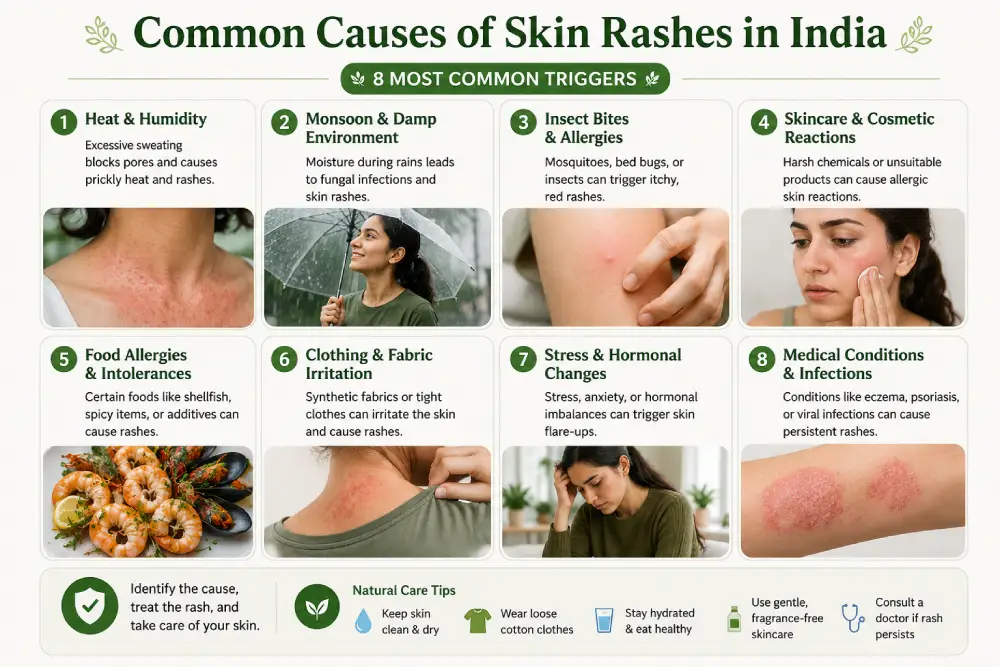
The Indian climate, diet, lifestyle and environment provide a unique (or at least far more prominent) set of rash inducing triggers
- Heat and sweat (Prickly Heat / Ghamori): the commonest rash in the India during summer particularly in humid areas. Sweat duct obstruction results in itchy minute red/white papulee on the neck, back, chest and skin folds.
- Allergic reactions: Reactions to foods (especially shellfish, peanuts, dairy, and spices), medications, latex, cosmetics, detergents and other synthetic agents are very common sources of generalised or localized rashes.
- Contact dermatitis that is when the skin happens to come into contact with an irritant nickel in jewelry, chemicals used in the dyes of clothing, soaps that are too harsh, the chemicals found in hair dye, or the juices from a plant or flower causing an itchy, sore, sometimes blistered rash, which is exactly where the skin had been coming into contact.
- Fungal infections: The moist conditions of India‘s monsoon season excite ringworm (tinea), jock itch (tinea cruris) and athlete‘s foot (tinea pedia). These are common in warm, humid nasal regions and reach epidemic levels in July–September.
- Insect bites and stings: Mosquitoes, bed-bugs, mites and ants are all present in India. Reactions to bite may present as small, raised papules or extensive allergic ‘hives’ especially in children.
- Viral infections: Chicken pox, measles, roseola and shingles (herpes zoster) all have characteristic skin rashes. Dengue fever becoming more prevalent throughout urban and semi-urban India can also have a distinctive spotted rash.
- Eczema (Atopic Dermatitis): Chronic inflammatory skin condition, with episodes of dry, itchy, inflamed patches. Common triggers in India include dry air due to air conditioning, harsh soaps, dust mites, and stress.
- Psoriasis: Thickened, scaly, silver-white patches. Usually on the elbows, knees, and areas of the scalp. Can be precipitated by stress, drugs, and infections.
- Seb-orrhoeic Dermatitis: A common condition which causes greasy, yellowish, greasy plaques on oily skin areas- scalp, face & chest. Exacerbated in dry, cold conditions and during stressful times.
Important fact: From a dermatology perspective, heat rash, contact dermatitis and fungal infections make up more than 60% of all rash presentations in outpatient dermatology clinics in urban India.
🔗 Read More: Skin Rash Prevention Tips: How to Protect Your Skin Year-Round
Common Types of Skin Rashes and Their Symptoms
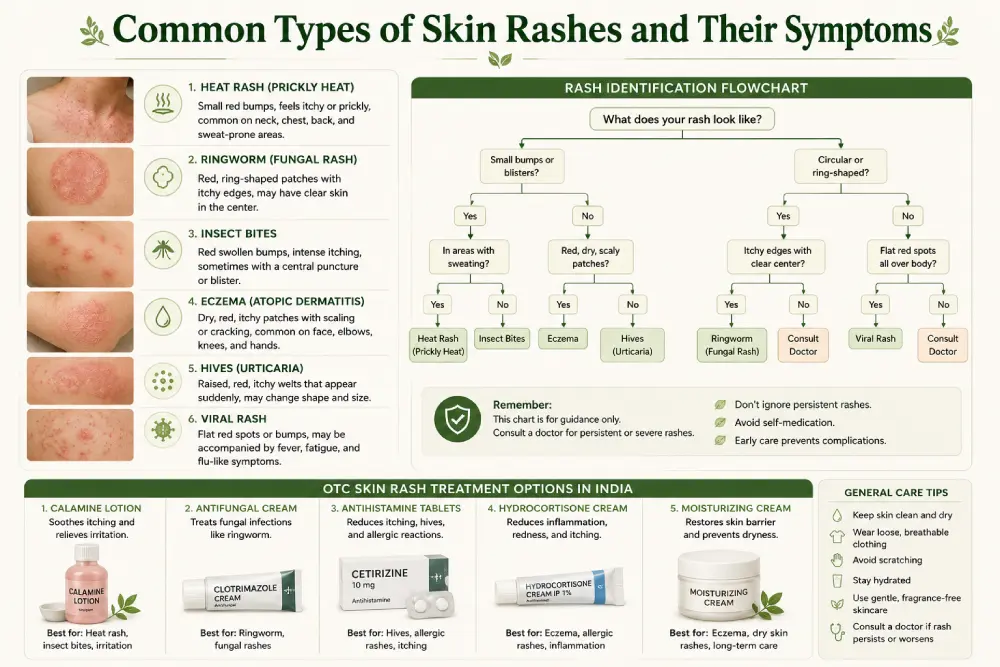
Proper diagnosis of your type of skin rash is probably the most important aspect of selecting the appropriate treatment. Knowing which type of rash you have is important, since various types of rashes look different, feel different and are located in different parts of the body and require very different courses of treatment. For example, using an antifungal cream on an allergic rash will be entirely useless and possibly aggravate the condition.
Use this identification guide as your first step:
| Rash Type | What It Looks Like | Where It Appears | Key Symptoms | Common Trigger (India) |
| Prickly Heat (Miliaria) | Small red or white bumps; sometimes filled with pus Came up as? | Neck, back, chest, under breast, armpit. | Prickling, burning sensation, itchy. | Hot humid weather, Sweat, tight clothes. |
| Hives (Urticaria) | Raised, pale red welts on skin that move and change shape; can merge into large patches | Any part of body; sometimes truck and limbs | Intense itching, sometimes accompanied by a sensation of burning or stinging | Food allergies, medication, insect stings, stress; |
| Contact Dermatitis | Red inflamed patch with concave or raised erythema to border matching site of contact; may blister | Precise location of contact with the irritant | Itching, burn, ooze, pain at contact site | Jewellery (nickel), synthetic fabric, hair dye, soap |
| Eczema (Atopic Dermatitis) | Dry, red, thickened, scaly patches; may crack or weep | Middle knees, spaces within elbows. | Severe itching worse at night, successive flares | Dust mites, dry skin, harsh soaps, stress, air conditioning |
| Ringworm (Tinea / Fungal) | Ring-shaped red patch with clearer centre; may have scaly border | Arms Legs Groin Scalp (tinea capitis) | Itching, spreading ring pattern, scaling | Monsoon season. Sharing towels. Warm moist skin. |
| Chickenpox Rash | Fluid filled blisters become crusted; all stages may be seen at the same time. | Face, scalp, trunk; spreads outward | Intense itching, fever, fatigue | Varicella virus, children and adults that have not received the vaccine |
| Psoriasis | Thick, raised plaques silver-white, scaly, on a red background | Your already-sensitive sensitivities include: ankles, knees, scalp, lower back10. | Itching burning, skin cracking and bleeding at plaque edges. | Stress infection medication inadequate nutrition injury to skin |
| Seborrhoeic Dermatitis | Yellowish, greasy, flaky on areas of the skin that are oily | Scalp. 7 eyebrows. Sides of nose. Ear canals. Chest | Slight itching, flaking and redness; dandruff if on scalp | Stress, dry climate., Immune system changes., Affecting the immune system. Malassezai yeast., |
| Insect Bite Reaction | Raised red spots, small; blisters may form in severe reactions | Where theexposedparts feet, arms, head. | Itchy, red, swollen, surrounding bite site | Mosquitoes, bedbugs, ants, mites |
| Drug Rash (Medication Reaction) | Variable — maculopapular (flat-and-raised red spots), hives, or in severe cases blistering | Often begins in trunk, encroaching symmetrically | Itching, fever possible; severe cases: blistering, mucous membrane involvement | Antibiotics (penicillin in particular), NSAIDs, anticonvulsants |
How to Tell the Difference: A Quick Self-Check
Before reaching for any treatment, ask yourself these three questions:
- When did the rash appear first and how did it spread? Contact dermatitis rash appears at the exact point where the metal watch strap contacts the skin. If the whole body erupts in a rash hours after eating a new food, it is probably hives.
- What about when you have good light on it? Fungal infections are ringed with a very obvious ‘label’ in the middle. Viral infections (chicken pox or shingles) look like blisters filled with fluid, grouped together. The itchy lumps (urticaria/hives) appear as flat swells, changing shape by the hour.
- What was different 24–72 hours before the rash appeared? Newly introduced soap, detergent, food, medication, cosmetic or clothing? This interval may identify contact and allergic reactions.
Important: If a rash is spreading quickly, causes swelling of the face or difficulty in breathing and is associated with a high temperature, this is an emergency. Proceed to your nearest Accident Emergency Department. Do not try to treat anaphylaxis or Stevens-Johnson Syndrome yourself.
🔗 Read More: Allergic Skin Rash Treatment: Identifying and Managing Allergic Reactions
Effective Skin Rash Treatments for Fast Relief
The treatment of skin rashes is completely tailored to the specific rash. Ironically, the treatment for prickly heat will have no effect in, and even aggravate, a fungal rash. A steroid cream that is perfect for calming an eczema flare should not be applied on a ringworm. Ensuring the rash treatment is specific to the type of rash is the most important factor to successful treatment.
Here is a comprehensive treatment map for the most common rash types encountered in India:
| Rash Type | First-Line Treatment | OTC Options (India) | What to Avoid | Timeline for Improvement |
| Prickly Heat / Heat Rash | Keep skin cool & dry, calamine lotion, loose cotton clothing | Lacto Calamine, Nycil Prickly Heat Powder, calamine lotion | Tight synthetics, hot shower, petroleum products. | You may have 2–5 days with adequate cooling and clothing. |
| Hives / Urticaria | Find and eliminate trigger; oral antihistamine | (Cetirizine 10mg, Loratadine, Fexofenadine are all available over the counter at pharmacy) | Known allergen; NSAID when medication-induced trigger | Hours to 1–2 days Chronic hives needs dermatologist |
| Mild Contact Dermatitis | Eliminate irritant, cleanse area if appropriate, hydrocortisone 1% cream | Application of hydrocortisone cream 1 %(Dr. Reddy‘s Cipla formulations) | More irritant contact; steroid onto broken skin | 3–7 days can be expected after the trigger has been removed PMID: |
| Eczema Flare | Moisturise intensively; mild topical steroid; identify trigger | Moisturiser: Cetaphil moisturiser Hydrocortisone cream 1% emollient based creams | Hot water, severe soap, scratching, identified personal triggers | 1–2 weeks; Chronic condition meaning it must be managed long term |
| Ringworm / Fungal Rash | Topical antifungal cream applied to rash and 2cm beyond border | Clotrimazole (Candid B, Canesten), Terbinafine (Terbicip, Lamisil) | Steroid-only creams; sharing towels; ceasing therapy prematurely | 2–4 weeks; scalp ringworm may require oral antifungal |
| Insect Bite Reaction | Cold pack; calamine; oral antihistamine to control itching | Calamine lotion. (a diff. lotion than calamineline) Cetrizine. Soframycin. (if infected) | Scratching (leads to infection); hot water on bite | 3–7 days for bite; hive reaction resolving within hours |
| Mild Drug Rash | Stop the causative medication (under medical guidance); antihistamine for itching | Cetirizine, calamine lotion for relief | Re-commencing the drug; self-treatment severe adverse drug reactions | Days weeks after drugs were stopped see GP beforetreatment. |
| Seborrhoeic Dermatitis | Medicated shampoo (ketoconazole or zinc pyrithione); antifungal/mild steroid cream for face | Nizoral Shampoo (Ketoconazole 2%), Selsun (Selenium Sulfide), Head & Shoulders | Products with Oil on scalp; not using anything while in remission | 1–4 weeks; lifelong management condition |
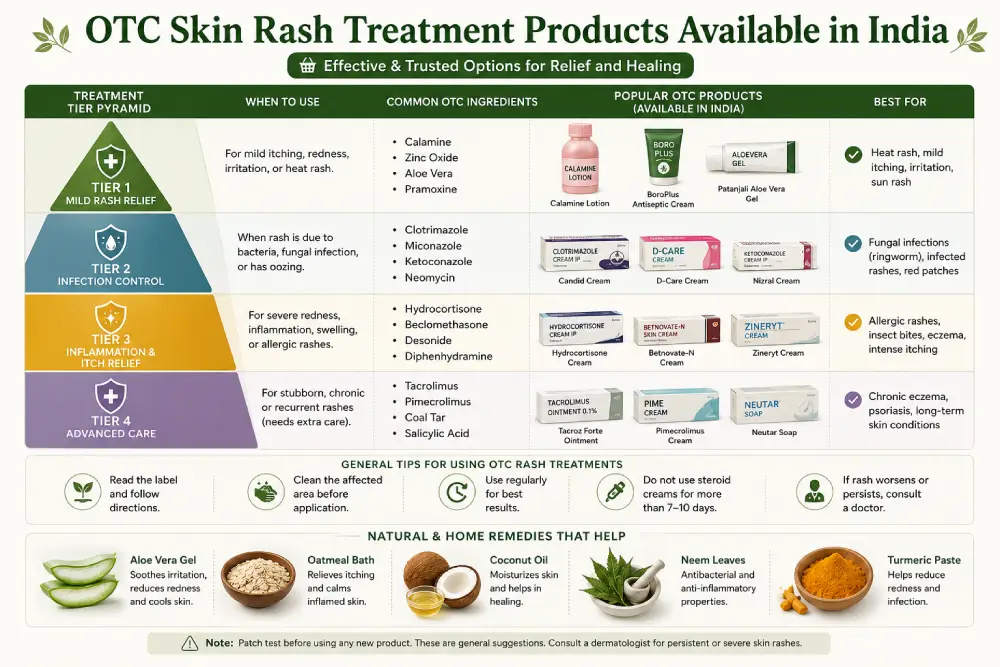
The 3-Tier Treatment Approach
For practical guidance, think of rash treatment in three tiers based on severity:
- Tier 1 Care at home: light non-spreading rash with identifiable cause and no systemic symptoms. Home remedies, over-the-counter creams and lifestyle change. Applies to most heat rashes, mild contact rashes and insect bites.
- Tier 2 OTC pharmacy treatment: Spreading rash, cause unknown or home remedies ineffective after 48 hours. Consult your pharmacist. Antihistamines, antifungal creams and 1% hydrocortisone are OTC.
- Tier 3 Dermatologist prescription: Extensive Rash persists longer than 2 weeks, gets worse or does not resolve with OTC treatment, infection suspected, experienced rash before. More potent topical steroids, oral antifungals, prescription antihistamines and immunomodulators require a prescription.
🔗 Read More: Best Skin Rash Creams & Medications in India: Complete OTC and Prescription Guide
Home Remedies for Treating Mild Skin Rashes
For mild, non-infectious rashes (heat rash, mild allergic reactions, irritant contact). Home remedies can be surprisingly effective and often the quickest route to comfort. Clearly the word here is ‘mild’. The simple remedies discussed are more appropriate for rashes that are localised rather than spreading, not infected, and do not have associated systemic symptoms such as fever.
Below are the home remedies for skin rashes that have the best evidence to support their use and below that are the remedies that sound promising but actually cause rashes to become increasingly aggravated:
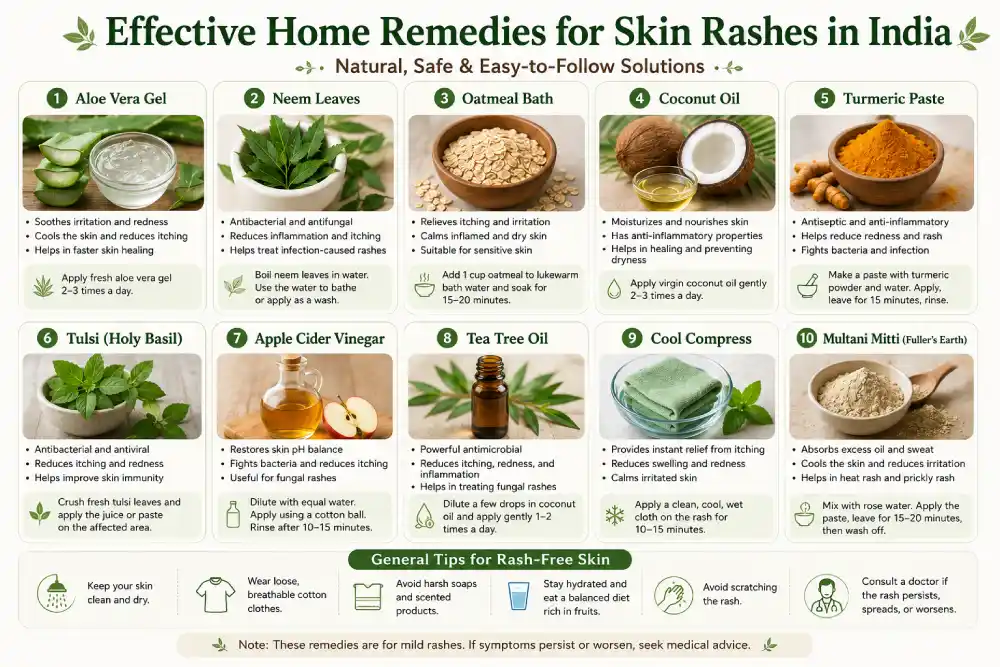
1. Cold Compress
The quickest and easiest treatment for itchy, inflamed rashes. A cold compress causes blood vessels (vasoconstriction) to constrict and this decreased blood flow will slow down inflammation, redness and itchiness within minuets. Simply take clean cloth, place a few ice cubes into it (never put ice directly onto skin!) and press onto the surface of the skin for 15–20 minuets. Repeat up to four times a day.
Best for: Hives (urticaria), insect bites, contact dermatitis, heat rash. Soothes inflammation by cooling and calming.
2. Calamine Lotion
The calamine, which is a combination of zinc oxide and iron oxide has been used for skin soothing for over 100 years. The compound forms a thin film on the skin, which is irritable. It has a mild anesthetic effect on the skin, and gentle astringent properties on the oozing rashes. It is, easily obtainable at all pharmacies throughout India, cheap and completely safe in children and adults.
Best for: Prickly heat, chickenpox, insect bites, mild contact rashes, hives. Apply a thin coat to clean dry skin. Leave to dry. Reapply 3-4 times daily.
3. Aloe Vera Gel
Fresh aloe vera gel (taken straight from the plant, rather than a bottle which may contain alcohol or perfume) is one of the best documented natural remedies for inflamed skin. The gel contains the anti-inflammatory, anti-microbial, moisturising agents acemannan and anthraquinones. Several clinical trials have demonstrated aloe to be a useful treatment for mild burns, contact dermatitis and psoriasis. Please cite as follows: Juice of aloe vera leaf and the gel from the plant have been identified as effectively reducing the severity of mild burns, contact dermatitis and psoriasis flares in several clinical trials.
Best for: Heat rash, sunburn rash, mild eczema, insect bites. Use fresh gel direct from plant leaf onto rash. Do not wash off. Keep leaf in fridge between applications. Avoid bottled aloe gels which contain fragrance or alcohol.
4. Oatmeal Bath (Colloidal Oatmeal)
Colloidal oatmeal, when added to a bath, is a soothing, anti-inflammatory soak, relieving itching almost instantaneously. Finely milled colistrium oatmeal (say colloidal oatmeal) in warm bathwater has been used effectively with the recognition of the effective anti-inflammatory properties in the relief of itchy inflamed skin. Itprotects and lubricates our skin as the phenol compounds act as inflammatory precursors.
Use for: Eczema, chickenpox, general hives, generalised itchy rashes. Use 1 cup of finely grinded plain oats (Old-fashioned oats blended into powder) in a tepid bath. Soak for 15 20 minutes. Pat dry do not rub. Follow with a fragrance free moisturiser.
5. Neem (Azadirachta indica)
Neem, one of the most historically and scientifically trialed skin remedies, for skin conditions in India, has significant scientific research behind it. The leaf extract has been found to have antibacterial, antifungal, antiinflammatory and antihistaminic properties. Boiling neem leaves in water and cooling for use as a skin wash, or dilute neem oil in a suitable oil and applying topically, can be used for fungal rashes, skin reactions to insect bites and light bacterial skin infections.
What for: Fungal rashes, reactions to insect bites, mild infected rashes. Use cooled neem water infusion as a skin wash 2 times daily. If using neem oil, dilute to 2–3% with a carrier oil, such as coconut or sesame. Do not apply undiluted to skin as it is a skin irritant.
6. Turmeric Paste
Curcumin is the active ingredient in turmeric (curcuitum) and boasts proven anti-inflammatory, antimicrobial qualities. A paste of turmeric powder and water, cooled milk or aloe vera gel can be used for mild rashes to lessen redness and itching. A word of warning for Indian skin types – turmeric stains yellow and can cause a temporary discolouration of the lighter tones of skin and light coloured clothing. Do not use on the face or on areas that would be affected by the yellow discolouration.
Best for: Mild inflammatory rashes on any part of the body where staining will not show. Combine 1 teaspoon turmeric and enough fresh water/raw milk to make a paste. Smear on rash. Leave 20 minutes. Wash off with cool water. Do at night.
7. Coconut Oil
Virgin coconut oil obtained cold-pressed contains lauric acid, which has been demonstrated to have antimicrobial activity and has moisturizing effects which soothe dry, itchy rashes. Coconut is useful in eczema. Several clinical trials have demonstrated the use of coconut oil in moisturizing atopic dermatitis to be comparable to mineral oil. It is comedogenic and should not be used if you have acne prone skin or a fungal rash, as it may worsen certain fungal infections.
Best for: Eczema, dry skin rashes, mild contact dermatitis on body. Apply a thin film to clean, slightly moist skin after bathing. Don‘t apply to face (comedogenic). Never apply to fungal rashes.
Home Remedies to Avoid Despite Popular Belief
| Commonly Suggested Remedy | Why It Can Make Things Worse |
| Lemon juice or citrus | Very acidic, causes chemical burns and intense hyperpigmentation over Indian skin tones when used with concurrent sun exposure (phytophotodermatitis) |
| Toothpaste | Contains menthol, fluoride and detergents that irritate any inflammed skin; no clinical evidence of benefit. |
| Baking soda paste | Disrupts skin‘s own p H (5.5); damages acid mantle; may exacerbate eczema & contact dermatitis |
| Rubbing alcohol or Hand sanitiser | – Breaks down the skin‘s lipid barrier, desiccates the rash, greatly increases irritation and susceptibility to infection |
| Bleach baths (undiluted) | A very dilute bleach bath (0.005%) does have some clinical evidence for the treatment of eczema under medical supervision. Bleach when used undiluted or sparingly diluted results in serious chemical burns. |
| Breast milk (for adult rashes) | Appropriate for some infant rashes; no evidence for adult skin rash treatment; potential contamination risk |
🔗 Read More: Skin Rash Treatment at Home: Complete Step-by-Step Guide with India-Specific Remedies
When you should visit your doctor for a skin rash.
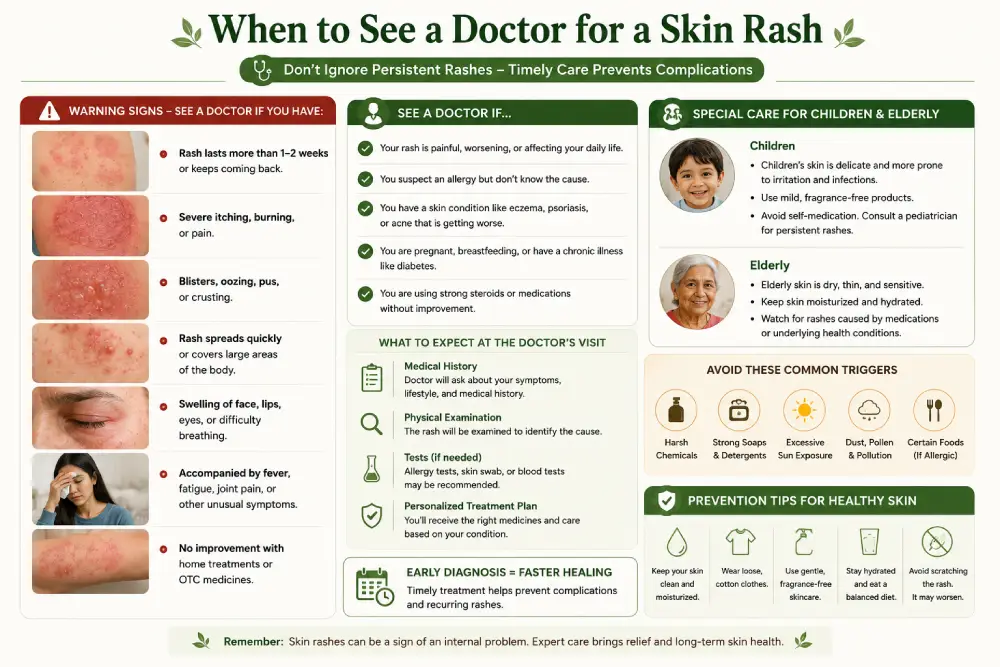
This is the most critical part of the guide and the most frequently ignored. People thinktheirrashes will disappear on their own, and in most cases they‘re correct. However, there is a certain set of warning signs that indicate your rash has crossed the line from “just a rash” to “serious condition,” and to continue avoiding professional treatment is a dangerous mistake.
Here is a straightforward, honest guide about when to continue self- medicating and when to make an appointment or go to ER now.
Self-Treat with Home Remedies or OTC Products If:
- This rash is small and local since it has not spread beyond its initial area.
- The source (heat, a new soap, an insect bite) can be readily identified.
- No fever, no face swelling, no breathing problem.
- The rash has existed for less than one week and is resolving
- Having had not experienced anaphylaxis in the past.
- The rash doesn‘t seem to be infected (no pus, increased warmth, streaking redness)
See a Doctor Within 1–2 Days If:
- The rash is traveling beyond the Local process or new areas are being affected
- Have shown no benefit following 48–72hours of home remedies or OTC treatments
- From definition is at the face, genitals, or in the framework of eyes – these nodes require family protection.
- You are pregnant many of the rash treatments need to be checked for safety in pregnancy
- A child younger than 2 years has any rash except for routine nappy rash
- The rash is very painful rather than itchy; pain may be a sign of shingles or something more sinister.
- You have a chronic condition (diabetes, immunosuppression, HIV). develop a skin rash.
- The rash develops in the context of new medication are either newly introduced or newly prescribed do not depose the medication without medical supervision.
Go to Emergency Care Immediately If:
Noted the weather warning signs Clearly life-threatening reactions requiring emergency treatment. Do not wait. Do not self manage. Go immediately to the casualty department of the nearest hospital.
- Additional signs of anaphylaxis include: Shortness of breath, constricting throat, wheezing
- Swelling of face, lips, tongue or throat happens quickly
- Rash appears on different parts of the body over the course of hours and spreads rapidly on the body.
- The skin is sloughing off or is blistering with widespread erosions possible Stevens-Johnson Syndrome (SJS)
- Temperature; particularly a high fever (greater than 39°C / 102°F) with the rash
- Rash: purple/dark red, does not blanch when pressure applied, so this is consistent with meningococcal infection or vasculitis.
- Sever joint pain and muscle weakness or concomitant with the rash.
What to Tell Your Doctor
Here is some information that will enable you to get a much quicker, much more accurate diagnosis when you do see either a doctor or dermatologist:
- When did they begin: specific date and whether evolution was rapid or slow
- Where it originated: And how its gradually become spreading over time.
- How it appears and feels: Is it itchy? Painful? Burning? Has there been a change in appearance?
- Any recent changes: New soap, detergent, food, medication, jewellery, fabric, travel or animal contact in the 72 hours prior to the rash in particular
- History: Any allergies, long standing problems or similar rashes in the past
- Photo documentation: Take a good photo of the rash at its worst. Rashes can look very different by the time of your appointment.
🔗 Read More: Heat Rash Treatment: Fast Relief Guide for India’s Climate
Myth vs. Fact: Skin Rash Treatments
| Myth | Fact |
| All skin rashes are contagious. | Most of the rashes (eczema, heat rash, contact dermatitis, hives) are not contagious at all. Fungal rashes and viral rashes (chicken pox, ringworm) are contagious and are spread by contact. |
| Steroid creams are safe to be used on any rash. | Never use topical steroids when patients have fungal or bacterial infections, as the immune response is suppressed, and the infection can spread rapidly. Never use on any rash that could be infectious. |
| If the rash doesn‘t itch, it‘s nothing to worry about | Some serious rashes — such as some drug reactions, vasculitis, or early Stevens-Johnson Syndrome– may initially be painless or least symptoms. Non-pruritic rashes that are spreading should be evaluated. |
| Home remedies are always safer than medication | However, several widely used home remedies (lemon juice, direct use of essential oils and bicarbonate of soda) have high potential to cause irritation and skin sensitization. All medications have to be administered by professionals and most OTC medications have more predictable, effective and desirable results than many common home remedies. |
| A rash that clears signifies it‘s healed | Some rashes (for example ‘eczema’, seborrhoeic dermatitis and psoriasis) are a chronic condition that go through episodes remission and flaring. Improvement does not mean a cure, and the commonest reason for relapse is stopping medication too soon. |
| People with darker skin do not develop rashes as readily. | Rashes on darker Indian skintones may appear different-brighter or darker brown or grey discolouration-as opposed to the red seen on lighter hue but equally important or widespread. |
Skin Rashes in India: Regional and Seasonal Considerations
Because of India’s incredible diversity of climate, ecology and culture, skin rashes are seen in different states of manifestation at different times of the year in different parts of the country. This allows you to predict, diagnose and treat rashes better than any standard international health book.
Summer (March–June): Heat Rash Season
Prickly heat (Heat rash) is quite prevalent across North India and Central India during the height of summer. The dominant temperature is over 40°C leading to widespread obstructed sweat ducts. The treatment is more environmental than clinical. The response to heat is to keep the body cool by the use of good cotton clothes (‘cap’ style top and pyjamas), not step out in the mid day sun, keep idle fans and cooling rooms on, and use cooling prickly heat powder or calamine lotion on the affected sites.
Photoallergic and phototoxic rashes or those resulting from UV exposure, sometimes involving certain drugs (tetracyclines, NSAIDS) or topical substances (citrus juice, many perfumes) are also most common in summer. If you are taking a drug and get a new rash on skin that has been exposed to the sun, say so.
Monsoon (July–September): Fungal Rash Season
The humidity profile of most Indian towns changes with the monsoon season. Continual moisture on the skin especially in the skin folds, under the breasts, between the toes and in the groin, provides a conducive environment for fungal infection. The peak of prevalence of ringworm, jock itch and athlete‘s foot occurs in the monsoon.
Prevention is simple but has to be actively followed: change out of wet clothes immediately, dry all skin folds after washing, use antifungals powders in moist areas, don‘t share towels, don‘t walk barefoot in communal wet areas, (gym showers, swimming pools and public bathrooms).
Bacterial skin infections tend to rise in the monsoon small cuts or insect bites can quickly become infected when the air is warm and moist. Any bite or wound which is becoming more inflamed, red, hot, swollen and/or producing pus within 24–48 hours needs to be examined by a doctor.
Winter (November–February): Eczema and Dry Skin Season
Winter air, dry and cold – especially in North India and higher altitudes – More than doubled transepidermal water loss and impairs the skin barrier. It is associated with most of the eczema and psoriasis exacerbations. Heating systems (room heaters, electric blankets) further lower room humidity and aggravate dry skin.
Barrier repair the winter management principle: intensive moisturisation with creams or petroleum jelly as soon as possible after bathing (most effective if within 3 minutes of getting out of a lukewarm shower), use humidifiers in bedrooms, and no hot baths which remove skin oils.
Urban India: Pollution and Contact Rashes
Delhi, Mumbai, Kolkata, Bengaluru are among the world‘s most polluted urban centers. Fine particles (PM2.5), nitrogen dioxide and ozone are deposited on exposed skin as they do on the lungs and may influence or aggravate skin inflammatory diseases such as contact dermatitis, eczema, inflamed and acned skin. The need to implement an everyday skin-care routine consisting of cleansing in order to remove those deposits, antioxidant application (Vitamin C, niacinamide) and physical barrier protection should be a growing concern for urban dwellers.
Best OTC Skin Rash Creams and Medications in India
India has great OTC 60mg pharmacy quality rashes medications available over the counter without the need of a prescirption. It is this useful reference guide, neatly sorted by rash type and active ingredient:
| Rash Category | Active Ingredient | Product Name (India) | Typical Cost (₹) | Where Available |
| Itch Relief (general) | Cetirizine 10mg (oral antihistamine) | Cetzine, Alerid, Zyrtec India | ₹15–₹40 per strip | All pharmacies; no prescription |
| Itch Relief (topical) | Calamine Lotion | Lacto Calamine, plain calamine | ₹80–₹200 | All pharmacies, supermarkets |
| Heat Rash | Zinc oxide + talc powder | Nycil Prickly Heat, Shower to Shower | ₹60–₹150 | Pharmacies, supermarkets, online |
| Mild Allergic Rash | Hydrocortisone 1% cream | Cortef cream, Clobetasol (various) | ₹80–₹180 | Pharmacy — ask specifically |
| Fungal Rash | Clotrimazole 1% | Candid cream, Canesten, Clotrin | ₹80–₹200 | All pharmacies; no prescription |
| Fungal Rash (alternative) | Terbinafine 1% | Terbicip cream, Lamisil cream | ₹120–₹280 | Pharmacies; no prescription |
| Eczema Moisturiser | Ceramides + hyaluronic acid | Cetaphil, CeraVe, Physiogel | ₹400–₹900 | Nykaa, pharmacies, Amazon |
| Infected Rash (minor) | Mupirocin / Framycetin | Bactroban, Soframycin cream | ₹80–₹250 | Pharmacies; minor antibiotic OTC |
| Seborrhoeic Dermatitis | Ketoconazole 2% shampoo | Nizoral shampoo | ₹200–₹350 | Pharmacies and Nykaa |
| Widespread Hives | Fexofenadine 120–180mg (oral) | Allegra, Fexova | ₹30–₹80 per strip | All pharmacies; no prescription |
Important note on steroid creams: Multiple combination creams available in India (Candid B, Betnovate-C, Panderm) contain a steroid combined with an antifungal and/or antibiotic. These are frequently misused for prolonged periods and can cause serious complications including skin thinning, steroid acne, and worsening of fungal infections. Use only as directed and for no longer than 7–10 days without medical supervision.
Final Summary: A Clear Action Plan for Skin Rash Treatments
Managing a skin rash can be uncomfortable, potentially quite frightening and is almost always an inconvenience. Most of the rashes and even the nastier looking ones are easy to treat just so long as the correct diagnosis is made early on.
Here is your step-by-step action plan:
- Step 1- What do you think it is? (Determine the most likely from this symptom table. Where might it be? What does it resemble? What occured 72hours before)?
- Step 2: look for an emergency. If there is any problem with: difficulty breathing, rapid spread, fever more than 39C, skin is peeling off, or a purple-red non-fading rash, you should go on to receive emergency care immediately.
- 3. Begin the right way: heat rash calamine and cool clothing; hives antihistamine; fungal antifungal cream; eczema moisturise and mild steroid.
- 4 Allow treatment to work: Mild rashes generally clear up after 48–72 hours of treating correctly. Do not change treatments until the first has been given enough time to work.
- Step 5 See a doctor if not getting any better: If the rash persists after being treated OTC for 3–5 days, see a dermatologist. Never ignore recurrent rash, see a doctor!
- Step 6 What to do to prevent the next one: Discover and remove yourself from your triggers. Prevention of skin rash is far cheaper and much easier than cure.
Treating skin rashes Well prepared is the first step in skin rash treatment understanding what you’re facing and finding the best method for the particular rash. Keep this page bookmarked so you can refer to it right away if a rash appears and pass it along to family members having the same questions.